题外话
Covid-19疫情的强烈反弹,小区里检测出了无症状感染者。小区封闭管理,我也不得不居家办公了。既然这么大把的时间可以光明正大的宅家里,自然要好好利用,八个字 == 努力工作,好好学习

这篇文章中,将详细讲解 生产者 -- 图形缓冲队列 -- 消费者 这个模型的的具体工作流程。我们还是从我们的demo运行流程着手。
可以再回头看看 Android 12(S) 图形显示系统 - 示例应用(二)
在demo示例中,我们获取buffer --> 填充数据 --> 送出显示的代码如下所示(做了简化):
// 9. dequeue a buffer ANativeWindowBuffer *nativeBuffer = nullptr; int hwcFD = -1; err = nativeWindow->dequeueBuffer(nativeWindow, &nativeBuffer, &hwcFD); // 10. make sure really control the dequeued buffer sp<Fence> hwcFence(new Fence(hwcFD)); int waitResult = hwcFence->waitForever("dequeueBuffer_EmptyNative"); // 11. fill buffer sp<GraphicBuffer> buf(GraphicBuffer::from(nativeBuffer)); uint8_t* img = nullptr; err = buf->lock(GRALLOC_USAGE_SW_WRITE_OFTEN, (void**)(&img)); fillRGBA8Buffer(img); err = buf->unlock(); // 13. queue the buffer to display int gpuFD = -1; err = nativeWindow->queueBuffer(nativeWindow, buf->getNativeBuffer(), gpuFD);获取图形缓冲区调用流程:
==> ANativeWindow::dequeueBuffer
==> Surface::hook_dequeueBuffer
==> Surface::dequeueBuffer
==> BufferQueueProducer::dequeueBuffer
填充数据后返还图形缓冲区的调用流程:
==> ANativeWindow::queueBuffer
==> Surface::hook_queueBuffer
==> Surface::queueBuffer
==> BufferQueueProducer::queueBuffer
前面文章讲解中提到,BLASTBufferQueue中创建Surface对象时,初始化其成员mGraphicBufferProducer,这个就是指向了一个GraphicBufferProducer对象。
当然,demo作为客户端仅仅是展示了生产者的工作,那消费者的工作又是如何的呢?
先用一张流程图概述一下:
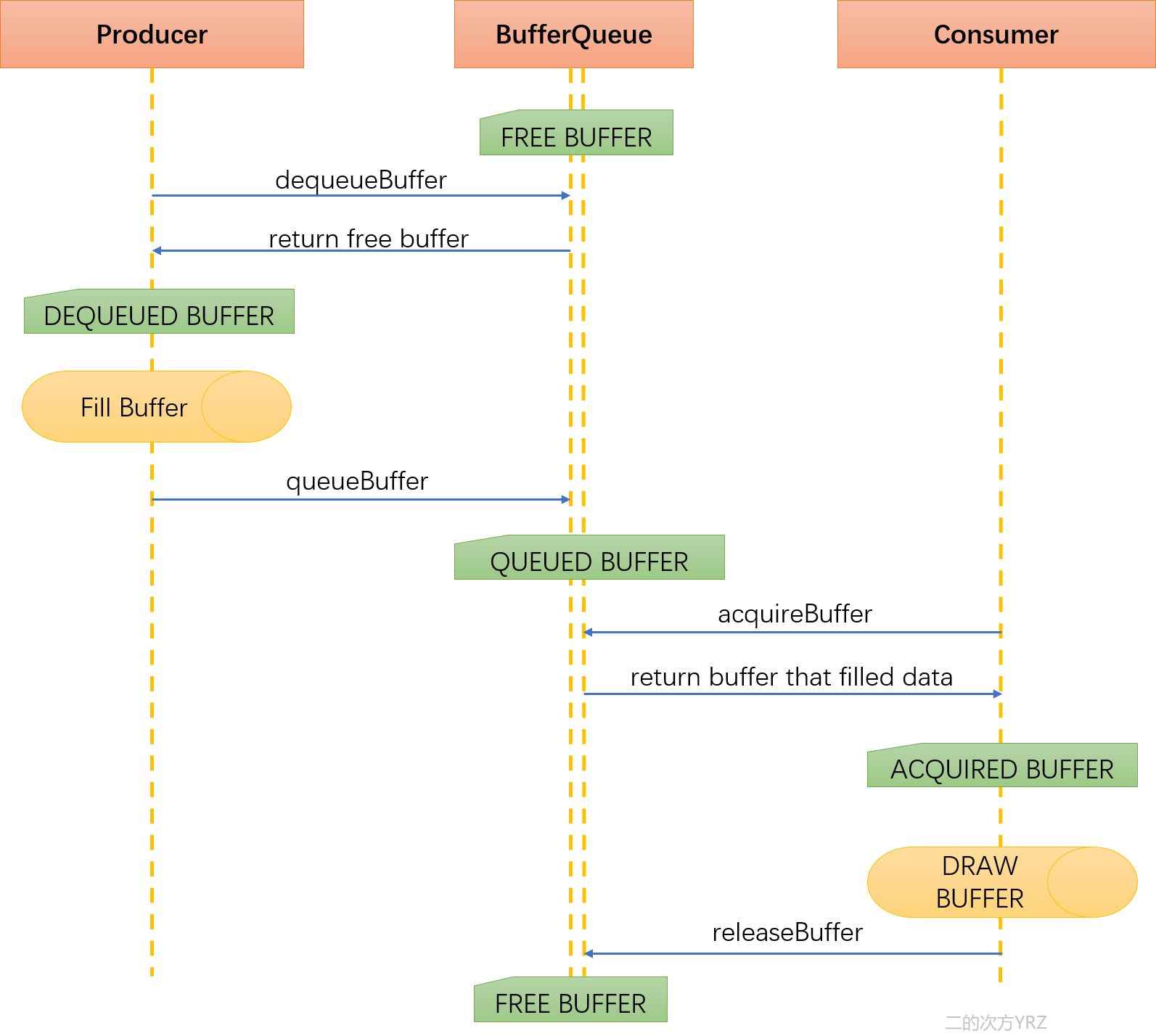
上图基本展示了BufferQueue的工作逻辑以及Buffer的流转过程和状态变化情况。
上图描述的流程我再重复唠叨一遍:
另外一点请留意各个函数调用后,对应的BufferSlot(GraphicBuffer)的状态变化。一般是这样的:
FREE -> DEQUEUED -> QUEUED -> ACQUIRED -> FREE
代码位置 :/frameworks/native/libs/gui/BufferQueueProducer.cpp
申请图形缓冲区,是从队列中取出一个可用的graphic buffer ,所以函数名叫dequeueBuffer ,它的作用是在应用程序一端准备绘制图像时,向BufferQueue申请一块可用的GraphicBuffer,有了这个buffer就可以把图像数据写入送去做处理和显示。
BufferQueueCore中mSlots数组管理缓冲区,最大容量是64,这个mSlots一开始静态分配了64个BufferSlot大小的空间,但是其中的数据缓冲区GraphicBuffer的分配是动态的,在需要时分配或重新分配。
dequeueBuffer流程
status_t BufferQueueProducer::dequeueBuffer(int* outSlot, sp<android::Fence>* outFence, uint32_t width, uint32_t height, PixelFormat format, uint64_t usage, uint64_t* outBufferAge, FrameEventHistoryDelta* outTimestamps) { ATRACE_CALL(); { // Autolock scope std::lock_guard<std::mutex> lock(mCore->mMutex); mConsumerName = mCore->mConsumerName; // BufferQueue已经被废弃,就直接返回了 if (mCore->mIsAbandoned) { BQ_LOGE("dequeueBuffer: BufferQueue has been abandoned"); return NO_INIT; } // 没有producer与BufferQueue建立连接,直接返回了 if (mCore->mConnectedApi == BufferQueueCore::NO_CONNECTED_API) { BQ_LOGE("dequeueBuffer: BufferQueue has no connected producer"); return NO_INIT; } } // Autolock scope BQ_LOGV("dequeueBuffer: w=%u h=%u format=%#x, usage=%#" PRIx64, width, height, format, usage); // 宽高信息不正常,直接返回 if ((width && !height) || (!width && height)) { BQ_LOGE("dequeueBuffer: invalid size: w=%u h=%u", width, height); return BAD_VALUE; } // 定义返回值并初始化 status_t returnFlags = NO_ERROR; EGLDisplay eglDisplay = EGL_NO_DISPLAY; EGLSyncKHR eglFence = EGL_NO_SYNC_KHR; bool attachedByConsumer = false; { // Autolock scope std::unique_lock<std::mutex> lock(mCore->mMutex); // If we don't have a free buffer, but we are currently allocating, we wait until allocation // is finished such that we don't allocate in parallel. // mFreeBuffers中存储的是绑定了GraphicBuffer且状态为FREE的BufferSlot; // mFreeBuffers为空,且正在分配GraphicBuffer内存时,需等待分配完成 if (mCore->mFreeBuffers.empty() && mCore->mIsAllocating) { mDequeueWaitingForAllocation = true; mCore->waitWhileAllocatingLocked(lock); // 等待 mDequeueWaitingForAllocation = false; mDequeueWaitingForAllocationCondition.notify_all(); } if (format == 0) { format = mCore->mDefaultBufferFormat; } // Enable the usage bits the consumer requested usage |= mCore->mConsumerUsageBits; const bool useDefaultSize = !width && !height; if (useDefaultSize) { width = mCore->mDefaultWidth; height = mCore->mDefaultHeight; if (mCore->mAutoPrerotation && (mCore->mTransformHintInUse & NATIVE_WINDOW_TRANSFORM_ROT_90)) { std::swap(width, height); } } // 寻找BufferSlot int found = BufferItem::INVALID_BUFFER_SLOT; while (found == BufferItem::INVALID_BUFFER_SLOT) { // 获取到可用的BufferSlot,它在mSlots的下标保存在found中,下面有讲解这个方法 status_t status = waitForFreeSlotThenRelock(FreeSlotCaller::Dequeue, lock, &found); if (status != NO_ERROR) { return status; } // This should not happen 没有找到可用的 if (found == BufferQueueCore::INVALID_BUFFER_SLOT) { BQ_LOGE("dequeueBuffer: no available buffer slots"); return -EBUSY; } //获取found索引对应的BufferSlot及对应的GraphicBuffer。后面需要为该GraphicBuffer分配空间 const sp<GraphicBuffer>& buffer(mSlots[found].mGraphicBuffer); // If we are not allowed to allocate new buffers, // waitForFreeSlotThenRelock must have returned a slot containing a // buffer. If this buffer would require reallocation to meet the // requested attributes, we free it and attempt to get another one. // 在不允许分配新的buffer时,waitForFreeSlotThenRelock必须返回一个绑定GraphicBuffer的slot. // 如果这个buffer需要重新分配来满足新要求的属性,我们必须释放它然后再重新请求一个。 if (!mCore->mAllowAllocation) { if (buffer->needsReallocation(width, height, format, BQ_LAYER_COUNT, usage)) { if (mCore->mSharedBufferSlot == found) { BQ_LOGE("dequeueBuffer: cannot re-allocate a sharedbuffer"); return BAD_VALUE; } mCore->mFreeSlots.insert(found); mCore->clearBufferSlotLocked(found); found = BufferItem::INVALID_BUFFER_SLOT; continue; } } } //到此,说明已经找到了一个BufferSlot const sp<GraphicBuffer>& buffer(mSlots[found].mGraphicBuffer); if (mCore->mSharedBufferSlot == found && buffer->needsReallocation(width, height, format, BQ_LAYER_COUNT, usage)) { BQ_LOGE("dequeueBuffer: cannot re-allocate a shared" "buffer"); return BAD_VALUE; } //如果不是共享buffer,就把这个BufferSlot对应的下标,加入到mActiveBuffers中 if (mCore->mSharedBufferSlot != found) { mCore->mActiveBuffers.insert(found); } *outSlot = found; // outSlot是最终返回给Surface ATRACE_BUFFER_INDEX(found); attachedByConsumer = mSlots[found].mNeedsReallocation; mSlots[found].mNeedsReallocation = false; //表示不需要重新分配空间 mSlots[found].mBufferState.dequeue(); // BufferSlot(BufferState)状态设置为dequeue // 这里再次判断buffer是否为空,或者是否需要重新分配空间 // needsReallocation方法判断buffer属性和请求的是否匹配,不匹配需要重新分配 if ((buffer == nullptr) || buffer->needsReallocation(width, height, format, BQ_LAYER_COUNT, usage)) { // 重置BufferSlot的变量值, mSlots[found].mAcquireCalled = false; mSlots[found].mGraphicBuffer = nullptr; mSlots[found].mRequestBufferCalled = false; mSlots[found].mEglDisplay = EGL_NO_DISPLAY; mSlots[found].mEglFence = EGL_NO_SYNC_KHR; mSlots[found].mFence = Fence::NO_FENCE; mCore->mBufferAge = 0; mCore->mIsAllocating = true; returnFlags |= BUFFER_NEEDS_REALLOCATION; } else { // We add 1 because that will be the frame number when this buffer // is queued mCore->mBufferAge = mCore->mFrameCounter + 1 - mSlots[found].mFrameNumber; } BQ_LOGV("dequeueBuffer: setting buffer age to %" PRIu64, mCore->mBufferAge); if (CC_UNLIKELY(mSlots[found].mFence == nullptr)) { BQ_LOGE("dequeueBuffer: about to return a NULL fence - " "slot=%d w=%d h=%d format=%u", found, buffer->width, buffer->height, buffer->format); } eglDisplay = mSlots[found].mEglDisplay; // 因为GraphicBuffer 最终是要到Gpu去消费,而当前的操作都是在cpu, // 为了同步cpu和Gpu对同一数据的使用,产生了这中Fence机制 eglFence = mSlots[found].mEglFence; // Don't return a fence in shared buffer mode, except for the first // frame. *outFence = (mCore->mSharedBufferMode && mCore->mSharedBufferSlot == found) ? Fence::NO_FENCE : mSlots[found].mFence; mSlots[found].mEglFence = EGL_NO_SYNC_KHR; mSlots[found].mFence = Fence::NO_FENCE; // If shared buffer mode has just been enabled, cache the slot of the // first buffer that is dequeued and mark it as the shared buffer. if (mCore->mSharedBufferMode && mCore->mSharedBufferSlot == BufferQueueCore::INVALID_BUFFER_SLOT) { mCore->mSharedBufferSlot = found; mSlots[found].mBufferState.mShared = true; } if (!(returnFlags & BUFFER_NEEDS_REALLOCATION)) { if (mCore->mConsumerListener != nullptr) { mCore->mConsumerListener->onFrameDequeued(mSlots[*outSlot].mGraphicBuffer->getId()); } } } // Autolock scope // //当前BufferSlot 是否需要分配空间 if (returnFlags & BUFFER_NEEDS_REALLOCATION) { BQ_LOGV("dequeueBuffer: allocating a new buffer for slot %d", *outSlot); // 使用Gralloc HAL进行内存分配,是在匿名内存中分配空间 sp<GraphicBuffer> graphicBuffer = new GraphicBuffer( width, height, format, BQ_LAYER_COUNT, usage, {mConsumerName.string(), mConsumerName.size()}); status_t error = graphicBuffer->initCheck(); { // Autolock scope std::lock_guard<std::mutex> lock(mCore->mMutex); if (error == NO_ERROR && !mCore->mIsAbandoned) { graphicBuffer->setGenerationNumber(mCore->mGenerationNumber); // 分配成功,把GraphicBuffer与对应的BufferSlot进行绑定 mSlots[*outSlot].mGraphicBuffer = graphicBuffer; if (mCore->mConsumerListener != nullptr) { mCore->mConsumerListener->onFrameDequeued( mSlots[*outSlot].mGraphicBuffer->getId()); } } // 分配完成,唤醒等待的线程 mCore->mIsAllocating = false; mCore->mIsAllocatingCondition.notify_all(); // 分配graphicBuffer 出错,把BufferSlot插入到mFreeSlots 等操作 if (error != NO_ERROR) { mCore->mFreeSlots.insert(*outSlot); mCore->clearBufferSlotLocked(*outSlot); BQ_LOGE("dequeueBuffer: createGraphicBuffer failed"); return error; } if (mCore->mIsAbandoned) { mCore->mFreeSlots.insert(*outSlot); mCore->clearBufferSlotLocked(*outSlot); BQ_LOGE("dequeueBuffer: BufferQueue has been abandoned"); return NO_INIT; } VALIDATE_CONSISTENCY(); } // Autolock scope } if (attachedByConsumer) { returnFlags |= BUFFER_NEEDS_REALLOCATION; } if (eglFence != EGL_NO_SYNC_KHR) { // 等待Buffer状态就绪,,然后fence围栏放行 EGLint result = eglClientWaitSyncKHR(eglDisplay, eglFence, 0, 1000000000); // If something goes wrong, log the error, but return the buffer without // synchronizing access to it. It's too late at this point to abort the // dequeue operation. if (result == EGL_FALSE) { BQ_LOGE("dequeueBuffer: error %#x waiting for fence", eglGetError()); } else if (result == EGL_TIMEOUT_EXPIRED_KHR) { BQ_LOGE("dequeueBuffer: timeout waiting for fence"); } eglDestroySyncKHR(eglDisplay, eglFence); } BQ_LOGV("dequeueBuffer: returning slot=%d/%" PRIu64 " buf=%p flags=%#x", *outSlot, mSlots[*outSlot].mFrameNumber, mSlots[*outSlot].mGraphicBuffer->handle, returnFlags); if (outBufferAge) { *outBufferAge = mCore->mBufferAge; } addAndGetFrameTimestamps(nullptr, outTimestamps); return returnFlags;}代码中都有做了注释,dequeue的主要逻辑基本展现了出来。
下面我们了看看其中的函数 waitForFreeSlotThenRelock,它的作用是在mSlot数组中查找FREE状态的slot,如果找到了就返回这个slot中的index
status_t BufferQueueProducer::waitForFreeSlotThenRelock(FreeSlotCaller caller, std::unique_lock<std::mutex>& lock, int* found) const { // // 标记 dequeueBuffer 还是attachBuffer 调用了它 auto callerString = (caller == FreeSlotCaller::Dequeue) ? "dequeueBuffer" : "attachBuffer"; bool tryAgain = true; // 在这个while循环,寻找可用的BufferSlot或发生错误退出 while (tryAgain) { if (mCore->mIsAbandoned) { BQ_LOGE("%s: BufferQueue has been abandoned", callerString); return NO_INIT; } int dequeuedCount = 0; // 统计mActiveBuffers中状态为DEQUEUED的BufferSlot数量 int acquiredCount = 0; // 统计mActiveBuffers中状态为ACQUIRED的BufferSlot数量 // mActiveBuffers表示已经绑定了GraphicBuffer且状态为非FREE的BufferSlot集合 for (int s : mCore->mActiveBuffers) { if (mSlots[s].mBufferState.isDequeued()) { ++dequeuedCount; } if (mSlots[s].mBufferState.isAcquired()) { ++acquiredCount; } } // Producers are not allowed to dequeue more than // mMaxDequeuedBufferCount buffers. // This check is only done if a buffer has already been queued // 判断是否超出了可以dequeue的buffer的最大数量 if (mCore->mBufferHasBeenQueued && dequeuedCount >= mCore->mMaxDequeuedBufferCount) { // Supress error logs when timeout is non-negative. if (mDequeueTimeout < 0) { BQ_LOGE("%s: attempting to exceed the max dequeued buffer " "count (%d)", callerString, mCore->mMaxDequeuedBufferCount); } return INVALID_OPERATION; } *found = BufferQueueCore::INVALID_BUFFER_SLOT; // If we disconnect and reconnect quickly, we can be in a state where // our slots are empty but we have many buffers in the queue. This can // cause us to run out of memory if we outrun the consumer. Wait here if // it looks like we have too many buffers queued up. // 获取BufferQueue最大buffer数量 const int maxBufferCount = mCore->getMaxBufferCountLocked(); // 当前mQueue中的Buffer 数量,是否大于maxBufferCount bool tooManyBuffers = mCore->mQueue.size() > static_cast<size_t>(maxBufferCount); if (tooManyBuffers) { BQ_LOGV("%s: queue size is %zu, waiting", callerString, mCore->mQueue.size()); } else { // If in shared buffer mode and a shared buffer exists, always // return it. // 共享buffer模式且有共享buffer存在,返回它 if (mCore->mSharedBufferMode && mCore->mSharedBufferSlot != BufferQueueCore::INVALID_BUFFER_SLOT) { *found = mCore->mSharedBufferSlot; } else { if (caller == FreeSlotCaller::Dequeue) { // 1. 从dequeueBuffer 中调用当前函数的 // 2. 优先从mFreeBuffers中寻找BufferSlot,getFreeBufferLocked获取mFreeBuffers队头的item // 3. mFreeBuffers找不到,再从mFreeSlots寻找BufferSlot,getFreeSlotLocked获取mFreeSlots队头的item // If we're calling this from dequeue, prefer free buffers int slot = getFreeBufferLocked(); if (slot != BufferQueueCore::INVALID_BUFFER_SLOT) { *found = slot; } else if (mCore->mAllowAllocation) { *found = getFreeSlotLocked(); } } else { //从attachBuffer 中调用当前函数的 // If we're calling this from attach, prefer free slots int slot = getFreeSlotLocked(); if (slot != BufferQueueCore::INVALID_BUFFER_SLOT) { *found = slot; } else { *found = getFreeBufferLocked(); } } } } // If no buffer is found, or if the queue has too many buffers // outstanding, wait for a buffer to be acquired or released, or for the // max buffer count to change. tryAgain = (*found == BufferQueueCore::INVALID_BUFFER_SLOT) || tooManyBuffers; // 获取失败,或者当前的Buffer 已经到达最大值,则重试 if (tryAgain) { // Return an error if we're in non-blocking mode (producer and // consumer are controlled by the application). // However, the consumer is allowed to briefly acquire an extra // buffer (which could cause us to have to wait here), which is // okay, since it is only used to implement an atomic acquire + // release (e.g., in GLConsumer::updateTexImage()) if ((mCore->mDequeueBufferCannotBlock || mCore->mAsyncMode) && (acquiredCount <= mCore->mMaxAcquiredBufferCount)) { return WOULD_BLOCK; } if (mDequeueTimeout >= 0) { std::cv_status result = mCore->mDequeueCondition.wait_for(lock, std::chrono::nanoseconds(mDequeueTimeout)); if (result == std::cv_status::timeout) { return TIMED_OUT; } } else { // 等待有buffer可以返回 mCore->mDequeueCondition.wait(lock); } } } // while (tryAgain) return NO_ERROR;}上述代码中也做了注释,可以直接阅读源码理解。
dequeueBuffer函数做的事情简单概括如下:
注:在查找可用的BufferSlot时,先去mFreeBuffers中找,找不到再去mFreeSlots中找。
@二的次方 写bug小能手

客户端/应用通过调用dequeueBuffer获取到一个可用的buffer后,就可以往这个buffer中填充数据了,在我们的demo中这一过程是在fillRGBA8Buffer函数内完成的,具体可见代码。
填充好数据后,就要把这个buffer再返还给BufferQueue,调用的方法是queueBuffer。
直接看源码
status_t BufferQueueProducer::queueBuffer(int slot, const QueueBufferInput &input, QueueBufferOutput *output) { ATRACE_CALL(); ATRACE_BUFFER_INDEX(slot); int64_t requestedPresentTimestamp; bool isAutoTimestamp; android_dataspace dataSpace; Rect crop(Rect::EMPTY_RECT); int scalingMode; uint32_t transform; uint32_t stickyTransform; sp<Fence> acquireFence; bool getFrameTimestamps = false; // 保存Surface传递过来的input里面封装的buffer信息 input.deflate(&requestedPresentTimestamp, &isAutoTimestamp, &dataSpace, &crop, &scalingMode, &transform, &acquireFence, &stickyTransform, &getFrameTimestamps); const Region& surfaceDamage = input.getSurfaceDamage(); const HdrMetadata& hdrMetadata = input.getHdrMetadata(); if (acquireFence == nullptr) { BQ_LOGE("queueBuffer: fence is NULL"); return BAD_VALUE; } auto acquireFenceTime = std::make_shared<FenceTime>(acquireFence); switch (scalingMode) { case NATIVE_WINDOW_SCALING_MODE_FREEZE: case NATIVE_WINDOW_SCALING_MODE_SCALE_TO_WINDOW: case NATIVE_WINDOW_SCALING_MODE_SCALE_CROP: case NATIVE_WINDOW_SCALING_MODE_NO_SCALE_CROP: break; default: BQ_LOGE("queueBuffer: unknown scaling mode %d", scalingMode); return BAD_VALUE; } // 回调接口,用于通知consumer sp<IConsumerListener> frameAvailableListener; sp<IConsumerListener> frameReplacedListener; int callbackTicket = 0; uint64_t currentFrameNumber = 0; BufferItem item; { // Autolock scope std::lock_guard<std::mutex> lock(mCore->mMutex); // BufferQueue是否被弃用 if (mCore->mIsAbandoned) { BQ_LOGE("queueBuffer: BufferQueue has been abandoned"); return NO_INIT; } // BufferQueue是否没有连的producer if (mCore->mConnectedApi == BufferQueueCore::NO_CONNECTED_API) { BQ_LOGE("queueBuffer: BufferQueue has no connected producer"); return NO_INIT; } // BufferSlot对应的slot序号是否合法,状态是否为DEQUEUE if (slot < 0 || slot >= BufferQueueDefs::NUM_BUFFER_SLOTS) { BQ_LOGE("queueBuffer: slot index %d out of range [0, %d)", slot, BufferQueueDefs::NUM_BUFFER_SLOTS); return BAD_VALUE; } else if (!mSlots[slot].mBufferState.isDequeued()) { BQ_LOGE("queueBuffer: slot %d is not owned by the producer " "(state = %s)", slot, mSlots[slot].mBufferState.string()); return BAD_VALUE; } else if (!mSlots[slot].mRequestBufferCalled) { // 是否调用了requestBuffer 函数 BQ_LOGE("queueBuffer: slot %d was queued without requesting " "a buffer", slot); return BAD_VALUE; } // If shared buffer mode has just been enabled, cache the slot of the // first buffer that is queued and mark it as the shared buffer. if (mCore->mSharedBufferMode && mCore->mSharedBufferSlot == BufferQueueCore::INVALID_BUFFER_SLOT) { mCore->mSharedBufferSlot = slot; mSlots[slot].mBufferState.mShared = true; } BQ_LOGV("queueBuffer: slot=%d/%" PRIu64 " time=%" PRIu64 " dataSpace=%d" " validHdrMetadataTypes=0x%x crop=[%d,%d,%d,%d] transform=%#x scale=%s", slot, mCore->mFrameCounter + 1, requestedPresentTimestamp, dataSpace, hdrMetadata.validTypes, crop.left, crop.top, crop.right, crop.bottom, transform, BufferItem::scalingModeName(static_cast<uint32_t>(scalingMode))); // 当前queue的具体GraphicBuffer const sp<GraphicBuffer>& graphicBuffer(mSlots[slot].mGraphicBuffer); // 根据当前的GraphicBufferd的宽高创建矩形区域 Rect bufferRect(graphicBuffer->getWidth(), graphicBuffer->getHeight()); // 创建裁剪区域 Rect croppedRect(Rect::EMPTY_RECT); // 裁剪区域 赋值为crop和bufferRect相交部分 crop.intersect(bufferRect, &croppedRect); if (croppedRect != crop) { BQ_LOGE("queueBuffer: crop rect is not contained within the " "buffer in slot %d", slot); return BAD_VALUE; } // Override UNKNOWN dataspace with consumer default if (dataSpace == HAL_DATASPACE_UNKNOWN) { dataSpace = mCore->mDefaultBufferDataSpace; } mSlots[slot].mFence = acquireFence; // 改变入队的BufferSlot的状态为QUEUED mSlots[slot].mBufferState.queue(); // Increment the frame counter and store a local version of it // for use outside the lock on mCore->mMutex. ++mCore->mFrameCounter; currentFrameNumber = mCore->mFrameCounter; mSlots[slot].mFrameNumber = currentFrameNumber; // 把BufferSlot中的信息封装为BufferItem,后续会把这个BufferItem加入到队列中 item.mAcquireCalled = mSlots[slot].mAcquireCalled; item.mGraphicBuffer = mSlots[slot].mGraphicBuffer; item.mCrop = crop; item.mTransform = transform & ~static_cast<uint32_t>(NATIVE_WINDOW_TRANSFORM_INVERSE_DISPLAY); item.mTransformToDisplayInverse = (transform & NATIVE_WINDOW_TRANSFORM_INVERSE_DISPLAY) != 0; item.mScalingMode = static_cast<uint32_t>(scalingMode); item.mTimestamp = requestedPresentTimestamp; item.mIsAutoTimestamp = isAutoTimestamp; item.mDataSpace = dataSpace; item.mHdrMetadata = hdrMetadata; item.mFrameNumber = currentFrameNumber; item.mSlot = slot; item.mFence = acquireFence; item.mFenceTime = acquireFenceTime; item.mIsDroppable = mCore->mAsyncMode || (mConsumerIsSurfaceFlinger && mCore->mQueueBufferCanDrop) || (mCore->mLegacyBufferDrop && mCore->mQueueBufferCanDrop) || (mCore->mSharedBufferMode && mCore->mSharedBufferSlot == slot); item.mSurfaceDamage = surfaceDamage; item.mQueuedBuffer = true; item.mAutoRefresh = mCore->mSharedBufferMode && mCore->mAutoRefresh; item.mApi = mCore->mConnectedApi; mStickyTransform = stickyTransform; // Cache the shared buffer data so that the BufferItem can be recreated. if (mCore->mSharedBufferMode) { mCore->mSharedBufferCache.crop = crop; mCore->mSharedBufferCache.transform = transform; mCore->mSharedBufferCache.scalingMode = static_cast<uint32_t>( scalingMode); mCore->mSharedBufferCache.dataspace = dataSpace; } output->bufferReplaced = false; if (mCore->mQueue.empty()) { // 如果mQueue队列为空,则直接push进入这个mQueue,不用考虑阻塞 // When the queue is empty, we can ignore mDequeueBufferCannotBlock // and simply queue this buffer mCore->mQueue.push_back(item); //取出BufferQueueCore的回调接口,下面调用这个接口的onFrameAvailable函数来通知Consumer frameAvailableListener = mCore->mConsumerListener; } else { // When the queue is not empty, we need to look at the last buffer // in the queue to see if we need to replace it const BufferItem& last = mCore->mQueue.itemAt( mCore->mQueue.size() - 1); if (last.mIsDroppable) { // 判断最后一个BufferItem是否可以丢弃 if (!last.mIsStale) { mSlots[last.mSlot].mBufferState.freeQueued(); // After leaving shared buffer mode, the shared buffer will // still be around. Mark it as no longer shared if this // operation causes it to be free. if (!mCore->mSharedBufferMode && mSlots[last.mSlot].mBufferState.isFree()) { mSlots[last.mSlot].mBufferState.mShared = false; } // Don't put the shared buffer on the free list. if (!mSlots[last.mSlot].mBufferState.isShared()) { mCore->mActiveBuffers.erase(last.mSlot); mCore->mFreeBuffers.push_back(last.mSlot); output->bufferReplaced = true; } } // Make sure to merge the damage rect from the frame we're about // to drop into the new frame's damage rect. if (last.mSurfaceDamage.bounds() == Rect::INVALID_RECT || item.mSurfaceDamage.bounds() == Rect::INVALID_RECT) { item.mSurfaceDamage = Region::INVALID_REGION; } else { item.mSurfaceDamage |= last.mSurfaceDamage; } // 用当前BufferItem,替换了队列最后一个BufferItem // Overwrite the droppable buffer with the incoming one mCore->mQueue.editItemAt(mCore->mQueue.size() - 1) = item; //取出回调接口,因为是替换,所以后续调用接口的函数 onFrameReplaced frameReplacedListener = mCore->mConsumerListener; } else { // 直接push进入这个mQueue mCore->mQueue.push_back(item); frameAvailableListener = mCore->mConsumerListener; } } // 表示 buffer已经queued,此时入队完成 mCore->mBufferHasBeenQueued = true; // mDequeueCondition是C++条件变量用作等待/唤醒,这里调用notify_all会唤醒调用了wait的线程 mCore->mDequeueCondition.notify_all(); mCore->mLastQueuedSlot = slot; //output 参数,会在Surface中继续使用 output->width = mCore->mDefaultWidth; output->height = mCore->mDefaultHeight; output->transformHint = mCore->mTransformHintInUse = mCore->mTransformHint; output->numPendingBuffers = static_cast<uint32_t>(mCore->mQueue.size()); output->nextFrameNumber = mCore->mFrameCounter + 1; ATRACE_INT(mCore->mConsumerName.string(), static_cast<int32_t>(mCore->mQueue.size()));#ifndef NO_BINDER mCore->mOccupancyTracker.registerOccupancyChange(mCore->mQueue.size());#endif // Take a ticket for the callback functions callbackTicket = mNextCallbackTicket++; VALIDATE_CONSISTENCY(); } // Autolock scope // It is okay not to clear the GraphicBuffer when the consumer is SurfaceFlinger because // it is guaranteed that the BufferQueue is inside SurfaceFlinger's process and // there will be no Binder call if (!mConsumerIsSurfaceFlinger) { item.mGraphicBuffer.clear(); } // Update and get FrameEventHistory. nsecs_t postedTime = systemTime(SYSTEM_TIME_MONOTONIC); NewFrameEventsEntry newFrameEventsEntry = { currentFrameNumber, postedTime, requestedPresentTimestamp, std::move(acquireFenceTime) }; addAndGetFrameTimestamps(&newFrameEventsEntry, getFrameTimestamps ? &output->frameTimestamps : nullptr); // Call back without the main BufferQueue lock held, but with the callback // lock held so we can ensure that callbacks occur in order int connectedApi; sp<Fence> lastQueuedFence; { // scope for the lock std::unique_lock<std::mutex> lock(mCallbackMutex); while (callbackTicket != mCurrentCallbackTicket) { mCallbackCondition.wait(lock); } //通知consumer,此处调用接口的不同,是有上面,是否替换最后一个BufferItem 决定的 if (frameAvailableListener != nullptr) { frameAvailableListener->onFrameAvailable(item); } else if (frameReplacedListener != nullptr) { frameReplacedListener->onFrameReplaced(item); } connectedApi = mCore->mConnectedApi; lastQueuedFence = std::move(mLastQueueBufferFence); mLastQueueBufferFence = std::move(acquireFence); mLastQueuedCrop = item.mCrop; mLastQueuedTransform = item.mTransform; ++mCurrentCallbackTicket; mCallbackCondition.notify_all(); } // Wait without lock held if (connectedApi == NATIVE_WINDOW_API_EGL) { // Waiting here allows for two full buffers to be queued but not a // third. In the event that frames take varying time, this makes a // small trade-off in favor of latency rather than throughput. lastQueuedFence->waitForever("Throttling EGL Production"); } return NO_ERROR;}
queueBuffer 的流程主要做了这两件事情:
到此queueBuffer 就分析完了。其中会调用了 mCore->mConsumerListener; 的回调接口,来通知consumer消费数据,那么这个回调接口是在何时被传入的,接口的是什么?
这个疑问留到下一篇单独讲解。
本文主要聚焦生产者一端的处理逻辑,分析了如何获取buffer以及填充数据后返还buffer的流程。
对照文章开头的那张图片,也只是讲了左半部分的逻辑,下一篇中我们就会涉足consumer的处理流程了。