1.Spring事件监听体系包括三个组件:事件、事件监听器,事件广播器。
事件:定义事件类型和事件源,需要继承ApplicationEvent。
package com.ybe.eventLisitener;import org.springframework.context.ApplicationEvent;public class OrderEvent extends ApplicationEvent { private String name; public OrderEvent(Object source,String name) { super(source); this.name = name; } public String getName() { return name; } public void setName(String name) { this.name = name; }}事件监听器:用来监听某一类的事件,并且执行具体业务逻辑,需要实现ApplicationListener
package com.ybe.eventLisitener;import org.springframework.context.ApplicationListener;import org.springframework.stereotype.Component;@Componentpublic class OrderEventListener implements ApplicationListener<OrderEvent> { @Override public void onApplicationEvent(OrderEvent event) { if(event.getName().equals("下订单")){ System.out.println("下单已完成..."); } }}package com.ybe.eventLisitener;import org.springframework.context.ApplicationListener;import org.springframework.context.event.EventListener;import org.springframework.stereotype.Component;@Componentpublic class OrderEventListenerByAnnotation { @EventListener(OrderEvent.class) public void onApplicationEvent(OrderEvent event) { if(event.getName().equals("下订单")){ System.out.println("下单已完成..."); } }}事件多播器:负责广播通知所有监听器,所有的事件监听器都注册在了事件多播器中。好比观察者模式中的被观察者。Spring容器默认生成的是同步事件多播器。可以自定义事件多播器,定义为异步方式。
import org.springframework.context.event.ApplicationEventMulticaster;import org.springframework.context.event.SimpleApplicationEventMulticaster;import org.springframework.core.task.SimpleAsyncTaskExecutor;import org.springframework.stereotype.Component;import java.util.Scanner;@Configuration@ComponentScan(value = "com.ybe")public class Config { @Bean public ApplicationEventMulticaster applicationEventMulticaster(){ SimpleApplicationEventMulticaster eventMulticaster = new SimpleApplicationEventMulticaster(); eventMulticaster.setTaskExecutor(new SimpleAsyncTaskExecutor()); return eventMulticaster; }}创建 AnnotationConfigApplicationContext 的过程中,会执行refresh()中的initApplicationEventMulticaster()方法。该方法先获取bean工厂,然后判断工厂是否包含了beanName 为 applicationEventMulticaster的bean。如果包含了,则获取该bean,赋值给applicationEventMulticaster 属性。如果没有,则创建一个 SimpleApplicationEventMulticaster 对象,并且赋值给 applicationEventMulticaster 。实现了源码如下:
/** * Initialize the ApplicationEventMulticaster. * Uses SimpleApplicationEventMulticaster if none defined in the context. * @see org.springframework.context.event.SimpleApplicationEventMulticaster */protected void initApplicationEventMulticaster() { // 获取当前bean工厂,一般是DefaultListableBeanFactory ConfigurableListableBeanFactory beanFactory = getBeanFactory(); // 判断容器中是否存在bdName为applicationEventMulticaster的bd, //也就是说自定义的事件监听多路广播器,必须实现 ApplicationEventMulticaster接口 if (beanFactory.containsLocalBean(APPLICATION_EVENT_MULTICASTER_BEAN_NAME)) { // 如果有,则从bean工厂得到这个bean对象 this.applicationEventMulticaster = beanFactory.getBean(APPLICATION_EVENT_MULTICASTER_BEAN_NAME, ApplicationEventMulticaster.class); if (logger.isTraceEnabled()) { logger.trace("Using ApplicationEventMulticaster [" + this.applicationEventMulticaster + "]"); } } else { // 如果没有,则默认采用SimpleApplicationEventMulticaster this.applicationEventMulticaster = new SimpleApplicationEventMulticaster(beanFactory); beanFactory.registerSingleton(APPLICATION_EVENT_MULTICASTER_BEAN_NAME, this.applicationEventMulticaster); if (logger.isTraceEnabled()) { logger.trace("No '" + APPLICATION_EVENT_MULTICASTER_BEAN_NAME + "' bean, using " + "[" + this.applicationEventMulticaster.getClass().getSimpleName() + "]"); } } }监听器的注册有两种,通过实现 ApplicationListener接口或者添加@EventListener注解。
注册的逻辑实现在refresh()中的registerListeners()方法里面。第一步,先获取当前ApplicationContext中已经添加的 applicationListeners(SpringMVC源码中有用到),遍历添加到多播器中。第二步,获取实现了ApplicationListener接口的listenerBeanNames集合,添加至多播器中。第三步,判断是否有早期事件,如果有则发起广播。
protected void registerListeners() { // Register statically specified listeners first. // 遍历应用程序中存在的监听器集合,并将对应的监听器添加到监听器的多路广播器中 for (ApplicationListener<?> listener : getApplicationListeners()) { getApplicationEventMulticaster().addApplicationListener(listener); } // Do not initialize FactoryBeans here: We need to leave all regular beans // uninitialized to let post-processors apply to them! // 从容器中获取所有实现了ApplicationListener接口的bd的bdName // 放入ApplicationListenerBeans集合中 String[] listenerBeanNames = getBeanNamesForType(ApplicationListener.class, true, false); for (String listenerBeanName : listenerBeanNames) { getApplicationEventMulticaster().addApplicationListenerBean(listenerBeanName); } // Publish early application events now that we finally have a multicaster... // 此处先发布早期的监听器集合 Set<ApplicationEvent> earlyEventsToProcess = this.earlyApplicationEvents; this.earlyApplicationEvents = null; if (!CollectionUtils.isEmpty(earlyEventsToProcess)) { for (ApplicationEvent earlyEvent : earlyEventsToProcess) { getApplicationEventMulticaster().multicastEvent(earlyEvent); } } }思考一下,上面的代码中第二步为啥添加的是listenerBeanName?
如果监听器是懒加载的话(即有@Lazy 注解)。那么在这个时候创建监听器显然是不对的,这个时候不能创建监听器。所以添加监听器到多播器的具体逻辑放在初始化具体的监听器之后。通过 BeanPostProcessor 的接口实现。具体的实现类是 ApplicationListenerDetector 。这个类是在 refreah()中prepareBeanFactory()方法中添加的。代码如下:
protected void prepareBeanFactory(ConfigurableListableBeanFactory beanFactory) { // Tell the internal bean factory to use the context's class loader etc. beanFactory.setBeanClassLoader(getClassLoader()); if (!shouldIgnoreSpel) { beanFactory.setBeanExpressionResolver(new StandardBeanExpressionResolver(beanFactory.getBeanClassLoader())); } beanFactory.addPropertyEditorRegistrar(new ResourceEditorRegistrar(this, getEnvironment())); // Configure the bean factory with context callbacks. beanFactory.addBeanPostProcessor(new ApplicationContextAwareProcessor(this)); beanFactory.ignoreDependencyInterface(EnvironmentAware.class); beanFactory.ignoreDependencyInterface(EmbeddedValueResolverAware.class); beanFactory.ignoreDependencyInterface(ResourceLoaderAware.class); beanFactory.ignoreDependencyInterface(ApplicationEventPublisherAware.class); beanFactory.ignoreDependencyInterface(MessageSourceAware.class); beanFactory.ignoreDependencyInterface(ApplicationContextAware.class); beanFactory.ignoreDependencyInterface(ApplicationStartupAware.class); // BeanFactory interface not registered as resolvable type in a plain factory. // MessageSource registered (and found for autowiring) as a bean. beanFactory.registerResolvableDependency(BeanFactory.class, beanFactory); beanFactory.registerResolvableDependency(ResourceLoader.class, this); beanFactory.registerResolvableDependency(ApplicationEventPublisher.class, this); beanFactory.registerResolvableDependency(ApplicationContext.class, this); // Register early post-processor for detecting inner beans as ApplicationListeners. // 添加 监听器后置处理器,在初始化具体的实现了 ApplicationListener 接口的Bean之后,进行调用。调用的是 // postProcessAfterInitialization()方法。 beanFactory.addBeanPostProcessor(new ApplicationListenerDetector(this)); // Detect a LoadTimeWeaver and prepare for weaving, if found. if (!NativeDetector.inNativeImage() && beanFactory.containsBean(LOAD_TIME_WEAVER_BEAN_NAME)) { beanFactory.addBeanPostProcessor(new LoadTimeWeaverAwareProcessor(beanFactory)); // Set a temporary ClassLoader for type matching. beanFactory.setTempClassLoader(new ContextTypeMatchClassLoader(beanFactory.getBeanClassLoader())); } // Register default environment beans. if (!beanFactory.containsLocalBean(ENVIRONMENT_BEAN_NAME)) { beanFactory.registerSingleton(ENVIRONMENT_BEAN_NAME, getEnvironment()); } if (!beanFactory.containsLocalBean(SYSTEM_PROPERTIES_BEAN_NAME)) { beanFactory.registerSingleton(SYSTEM_PROPERTIES_BEAN_NAME, getEnvironment().getSystemProperties()); } if (!beanFactory.containsLocalBean(SYSTEM_ENVIRONMENT_BEAN_NAME)) { beanFactory.registerSingleton(SYSTEM_ENVIRONMENT_BEAN_NAME, getEnvironment().getSystemEnvironment()); } if (!beanFactory.containsLocalBean(APPLICATION_STARTUP_BEAN_NAME)) { beanFactory.registerSingleton(APPLICATION_STARTUP_BEAN_NAME, getApplicationStartup()); } }在创建 AnnotationConfigApplicationContext 的构造方法中,会执行org.springframework.context.annotation.AnnotationConfigUtils#registerAnnotationConfigProcessors(org.springframework.beans.factory.support.BeanDefinitionRegistry, java.lang.Object) 方法。这个方法中会添加两个 beanDefs, 代码如下:
if (!registry.containsBeanDefinition(EVENT_LISTENER_PROCESSOR_BEAN_NAME)) { RootBeanDefinition def = new RootBeanDefinition(EventListenerMethodProcessor.class); def.setSource(source); beanDefs.add(registerPostProcessor(registry, def, EVENT_LISTENER_PROCESSOR_BEAN_NAME));}if (!registry.containsBeanDefinition(EVENT_LISTENER_FACTORY_BEAN_NAME)) { RootBeanDefinition def = new RootBeanDefinition(DefaultEventListenerFactory.class); def.setSource(source); beanDefs.add(registerPostProcessor(registry, def, EVENT_LISTENER_FACTORY_BEAN_NAME));}EventListenerMethodProcessor:事件监听器的BeanFactory后置处理器,在前期会创建 DefaultEventListenerFactory ,后期在创建好Bean之后,根据 EventListener 属性,调用DefaultEventListenerFactory创建具体的 ApplicationListenerMethodAdapter 。
DefaultEventListenerFactory:监听器的创建工厂,用来创建 ApplicationListenerMethodAdapter 。
EventListenerMethodProcessor 的类继承图如下:
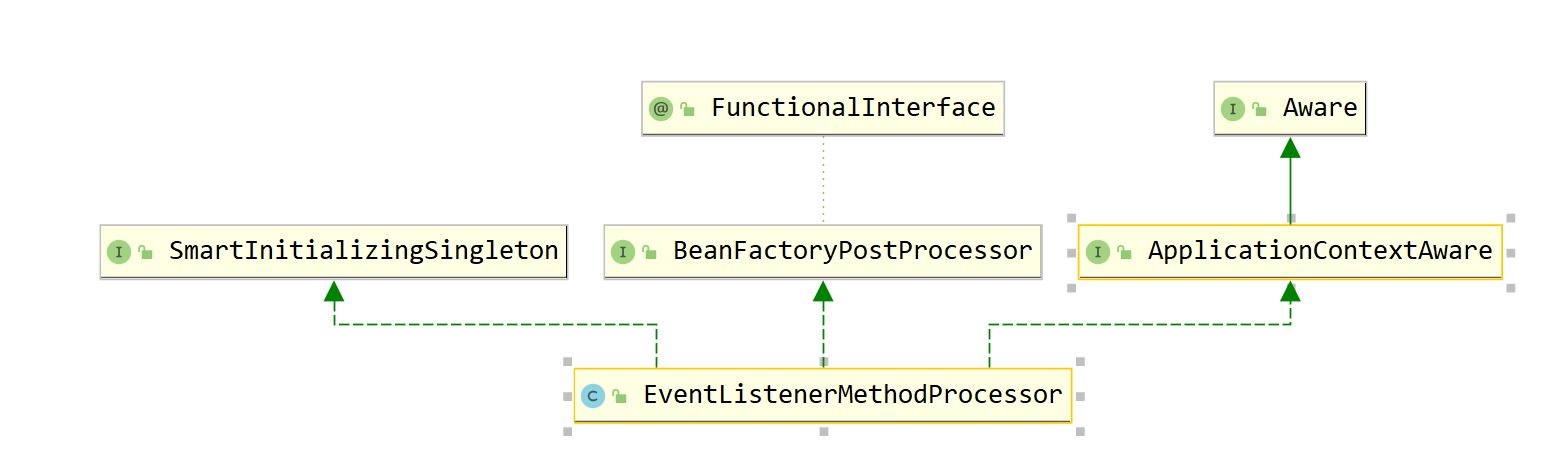
在refreash的invokeBeanFactoryPostProcessors()中会调用 org.springframework.context.event.EventListenerMethodProcessor#postProcessBeanFactory方法,获取EventListenerFactory 类型的 Bean。代码如下:
@Override public void postProcessBeanFactory(ConfigurableListableBeanFactory beanFactory) { this.beanFactory = beanFactory; // 获取或创建 EventListenerFactory 类型的 Bean Map<String, EventListenerFactory> beans = beanFactory.getBeansOfType(EventListenerFactory.class, false, false); List<EventListenerFactory> factories = new ArrayList<>(beans.values()); AnnotationAwareOrderComparator.sort(factories); this.eventListenerFactories = factories; }在 org.springframework.beans.factory.support.DefaultListableBeanFactory#preInstantiateSingletons 方法中,创建完所有的单例Bean 之后,会遍历所有Bean是否实现了 SmartInitializingSingleton 接口。如果实现接口会执行该 Bean 的 afterSingletonsInstantiated() 方法。代码如下:
public void preInstantiateSingletons() throws BeansException { if (logger.isTraceEnabled()) { logger.trace("Pre-instantiating singletons in " + this); } // Iterate over a copy to allow for init methods which in turn register new bean definitions. // While this may not be part of the regular factory bootstrap, it does otherwise work fine. // 将所有BeanDefinition的名字创建一个集合 List<String> beanNames = new ArrayList<>(this.beanDefinitionNames); // Trigger initialization of all non-lazy singleton beans... // 触发所有非延迟加载单例bean的初始化,遍历集合的对象 for (String beanName : beanNames) { // 合并父类BeanDefinition RootBeanDefinition bd = getMergedLocalBeanDefinition(beanName); // 条件判断,抽象,单例,非懒加载 if (!bd.isAbstract() && bd.isSingleton() && !bd.isLazyInit()) { // 判断是否实现了FactoryBean接口 if (isFactoryBean(beanName)) { // 根据&+beanName来获取具体的对象 Object bean = getBean(FACTORY_BEAN_PREFIX + beanName); // 进行类型转换 if (bean instanceof FactoryBean) { FactoryBean<?> factory = (FactoryBean<?>) bean; // 判断这个FactoryBean是否希望立即初始化 boolean isEagerInit; if (System.getSecurityManager() != null && factory instanceof SmartFactoryBean) { isEagerInit = AccessController.doPrivileged( (PrivilegedAction<Boolean>) ((SmartFactoryBean<?>) factory)::isEagerInit, getAccessControlContext()); } else { isEagerInit = (factory instanceof SmartFactoryBean && ((SmartFactoryBean<?>) factory).isEagerInit()); } // 如果希望急切的初始化,则通过beanName获取bean实例 if (isEagerInit) { getBean(beanName); } } } else { // 如果beanName对应的bean不是FactoryBean,只是普通的bean,通过beanName获取bean实例 getBean(beanName); } } } // Trigger post-initialization callback for all applicable beans... // 遍历beanNames,触发所有SmartInitializingSingleton的后初始化回调 for (String beanName : beanNames) { // 获取beanName对应的bean实例 Object singletonInstance = getSingleton(beanName); // 判断singletonInstance是否实现了SmartInitializingSingleton接口 if (singletonInstance instanceof SmartInitializingSingleton) { // 类型转换 SmartInitializingSingleton smartSingleton = (SmartInitializingSingleton) singletonInstance; // 触发SmartInitializingSingleton实现类的afterSingletonsInstantiated方法 if (System.getSecurityManager() != null) { AccessController.doPrivileged((PrivilegedAction<Object>) () -> { smartSingleton.afterSingletonsInstantiated(); return null; }, getAccessControlContext()); } else { smartSingleton.afterSingletonsInstantiated(); } } } }org.springframework.context.event.EventListenerMethodProcessor#afterSingletonsInstantiated 中会调用私有方法 processBean()进行 ApplicationEventAdatper 的创建。代码如下:
/** * 该方法拿到某个bean的名称和它的目标类,再这个范围上检测@EventListener注解方法,生成和注册 ApplicationListenerMethodAdapter 实例 * @param beanName * @param targetType */ private void processBean(final String beanName, final Class<?> targetType) { if (!this.nonAnnotatedClasses.contains(targetType) && AnnotationUtils.isCandidateClass(targetType, EventListener.class) && !isSpringContainerClass(targetType)) { Map<Method, EventListener> annotatedMethods = null; try { // 检测当前类targetType上使用了注解@EventListener的方法 annotatedMethods = MethodIntrospector.selectMethods(targetType, (MethodIntrospector.MetadataLookup<EventListener>) method -> AnnotatedElementUtils.findMergedAnnotation(method, EventListener.class)); } catch (Throwable ex) { // An unresolvable type in a method signature, probably from a lazy bean - let's ignore it. if (logger.isDebugEnabled()) { logger.debug("Could not resolve methods for bean with name '" + beanName + "'", ex); } } if (CollectionUtils.isEmpty(annotatedMethods)) { // 如果当前类targetType中没有任何使用了注解@EventListener的方法,则将该类保存到缓存nonAnnotatedClasses,从而 // 避免当前处理方法重入该类,避免二次处理 this.nonAnnotatedClasses.add(targetType); if (logger.isTraceEnabled()) { logger.trace("No @EventListener annotations found on bean class: " + targetType.getName()); } } else { // Non-empty set of methods // 如果当前类targetType中有些方法使用了注解@EventListener,那么根据方法上的信息对应的创建和注册ApplicationListener实例 ConfigurableApplicationContext context = this.applicationContext; Assert.state(context != null, "No ApplicationContext set"); // 此处使用了this.eventListenerFactories,这些EventListenerFactory是在该类postProcessBeanFactory方法调用时被记录的 List<EventListenerFactory> factories = this.eventListenerFactories; Assert.state(factories != null, "EventListenerFactory List not initialized"); for (Method method : annotatedMethods.keySet()) { for (EventListenerFactory factory : factories) { if (factory.supportsMethod(method)) { Method methodToUse = AopUtils.selectInvocableMethod(method, context.getType(beanName)); // 如果当前EventListenerFactory支持处理该@EventListener注解的方法,则使用它创建 ApplicationListenerMethodAdapter ApplicationListener<?> applicationListener = factory.createApplicationListener(beanName, targetType, methodToUse); if (applicationListener instanceof ApplicationListenerMethodAdapter) { ((ApplicationListenerMethodAdapter) applicationListener).init(context, this.evaluator); } // 将创建的ApplicationListener加入到容器中 context.addApplicationListener(applicationListener); break; } } } if (logger.isDebugEnabled()) { logger.debug(annotatedMethods.size() + " @EventListener methods processed on bean '" + beanName + "': " + annotatedMethods); } } } }可以通过调用 org.springframework.context.support.AbstractApplicationContext#publishEvent(java.lang.Object, org.springframework.core.ResolvableType) 方法进行事件的调用。代码如下:
/** * 将给定事件发布到所有监听器 */ protected void publishEvent(Object event, @Nullable ResolvableType eventType) { // 如果event为null,抛出异常 Assert.notNull(event, "Event must not be null"); // Decorate event as an ApplicationEvent if necessary // 装饰事件作为一个应用事件,如果有必要 ApplicationEvent applicationEvent; // 如果event是ApplicationEvent的实例 if (event instanceof ApplicationEvent) { // 将event强转为ApplicationEvent对象 applicationEvent = (ApplicationEvent) event; } else { // PayloadApplicationEvent:携带任意有效负载的ApplicationEvent。 // 创建一个新的PayloadApplicationEvent applicationEvent = new PayloadApplicationEvent<>(this, event); // 如果eventType为 null if (eventType == null) { // 将applicationEvent转换为PayloadApplicationEvent 象,引用其ResolvableType对象 eventType = ((PayloadApplicationEvent<?>) applicationEvent).getResolvableType(); } } // Multicast right now if possible - or lazily once the multicaster is initialized // 如果可能的话,现在就进行组播——或者在组播初始化后延迟 // earlyApplicationEvents:在多播程序设置之前发布的ApplicationEvent // 如果earlyApplicationEvents不为 null,这种情况只在上下文的多播器还没有初始化的情况下才会成立,会将applicationEvent // 添加到earlyApplicationEvents保存起来,待多博器初始化后才继续进行多播到适当的监听器 if (this.earlyApplicationEvents != null) { //将applicationEvent添加到 earlyApplicationEvents this.earlyApplicationEvents.add(applicationEvent); } else { // 多播applicationEvent到适当的监听器 getApplicationEventMulticaster().multicastEvent(applicationEvent, eventType); } // Publish event via parent context as well... // 通过父上下文发布事件 // 如果parent不为null if (this.parent != null) { // 如果parent是AbstractApplicationContext的实例 if (this.parent instanceof AbstractApplicationContext) { // 将event多播到所有适合的监听器。如果event不是ApplicationEvent实例,会将其封装成PayloadApplicationEvent对象再进行多播 ((AbstractApplicationContext) this.parent).publishEvent(event, eventType); } else { // 通知与event事件应用程序注册的所有匹配的监听器 this.parent.publishEvent(event); } } }SimpleApplicationEventMulticaster 中的 multicasEvent,invokeListener,doInvokeListener 三个方法代码如下:
/** * 将给定事件发布到所有监听器 */ protected void publishEvent(Object event, @Nullable ResolvableType eventType) { // 如果event为null,抛出异常 Assert.notNull(event, "Event must not be null"); // Decorate event as an ApplicationEvent if necessary // 装饰事件作为一个应用事件,如果有必要 ApplicationEvent applicationEvent; // 如果event是ApplicationEvent的实例 if (event instanceof ApplicationEvent) { // 将event强转为ApplicationEvent对象 applicationEvent = (ApplicationEvent) event; } else { // PayloadApplicationEvent:携带任意有效负载的ApplicationEvent。 // 创建一个新的PayloadApplicationEvent applicationEvent = new PayloadApplicationEvent<>(this, event); // 如果eventType为 null if (eventType == null) { // 将applicationEvent转换为PayloadApplicationEvent 象,引用其ResolvableType对象 eventType = ((PayloadApplicationEvent<?>) applicationEvent).getResolvableType(); } } // Multicast right now if possible - or lazily once the multicaster is initialized // 如果可能的话,现在就进行组播——或者在组播初始化后延迟 // earlyApplicationEvents:在多播程序设置之前发布的ApplicationEvent // 如果earlyApplicationEvents不为 null,这种情况只在上下文的多播器还没有初始化的情况下才会成立,会将applicationEvent // 添加到earlyApplicationEvents保存起来,待多博器初始化后才继续进行多播到适当的监听器 if (this.earlyApplicationEvents != null) { //将applicationEvent添加到 earlyApplicationEvents this.earlyApplicationEvents.add(applicationEvent); } else { // 多播applicationEvent到适当的监听器 getApplicationEventMulticaster().multicastEvent(applicationEvent, eventType); } // Publish event via parent context as well... // 通过父上下文发布事件 // 如果parent不为null if (this.parent != null) { // 如果parent是AbstractApplicationContext的实例 if (this.parent instanceof AbstractApplicationContext) { // 将event多播到所有适合的监听器。如果event不是ApplicationEvent实例,会将其封装成PayloadApplicationEvent对象再进行多播 ((AbstractApplicationContext) this.parent).publishEvent(event, eventType); } else { // 通知与event事件应用程序注册的所有匹配的监听器 this.parent.publishEvent(event); } } } protected void invokeListener(ApplicationListener<?> listener, ApplicationEvent event) { // 获取此多播器的当前错误处理程序 ErrorHandler errorHandler = getErrorHandler(); // 如果errorHandler不为null if (errorHandler != null) { try { // 回调listener的onApplicationEvent方法,传入event doInvokeListener(listener, event); } catch (Throwable err) { // 交给errorHandler接收处理err errorHandler.handleError(err); } } else { // 回调listener的onApplicationEvent方法,传入event doInvokeListener(listener, event); } } /** * 回调listener的onApplicationEvent方法,传入 event * @param listener * @param event */ @SuppressWarnings({"rawtypes", "unchecked"}) private void doInvokeListener(ApplicationListener listener, ApplicationEvent event) { try { //回调listener的onApplicationEvent方法,传入 event:contextrefreshListener:onapplicaitonEvent:FrameworkServlet.this.onApplicationEvent() listener.onApplicationEvent(event); } catch (ClassCastException ex) { //获取异常信息 String msg = ex.getMessage(); if (msg == null || matchesClassCastMessage(msg, event.getClass())) { // Possibly a lambda-defined listener which we could not resolve the generic event type for // -> let's suppress the exception and just log a debug message. Log logger = LogFactory.getLog(getClass()); if (logger.isTraceEnabled()) { logger.trace("Non-matching event type for listener: " + listener, ex); } } else { //抛出异常 throw ex; } } }SpringMVC中就是通过Spring的事件机制进行九大组件的初始化。
监听器定义在FrameworkServlet类中,作为内部类。代码如下:
private class ContextRefreshListener implements ApplicationListener<ContextRefreshedEvent> { @Override public void onApplicationEvent(ContextRefreshedEvent event) { FrameworkServlet.this.onApplicationEvent(event); } }监听器的添加在org.springframework.web.servlet.FrameworkServlet#configureAndRefreshWebApplicationContext 中进行。通过SourceFilteringListener进行包装。添加代码如下:
// 添加监听器sourceFilteringListener到wac中,实际监听的是ContextRefreshListener所监听的事件,监听ContextRefreshedEvent事件, // 当接收到消息之后会调用onApplicationEvent方法,调用onRefresh方法,并将refreshEventReceived标志设置为true,表示已经refresh过 wac.addApplicationListener(new SourceFilteringListener(wac, new ContextRefreshListener()));在refresh中的registerListeners方法进行添加,代码如下:
// Register statically specified listeners first. // 遍历应用程序中存在的监听器集合,并将对应的监听器添加到监听器的多路广播器中 for (ApplicationListener<?> listener : getApplicationListeners()) { getApplicationEventMulticaster().addApplicationListener(listener); }在refresh中的finishRefresh()方法中,会调用publishEvnet(new ContextRefreshedEvent(this))发布事件。进行多播器广播,代码如下
// 多播applicationEvent到适当的监听器getApplicationEventMulticaster().multicastEvent(applicationEvent, eventType);最终会调到FrameworkServlet.this.onApplicationEvent(event)。
public void onApplicationEvent(ContextRefreshedEvent event) { // 标记 refreshEventReceived 为true this.refreshEventReceived = true; synchronized (this.onRefreshMonitor) { // 处理事件中的 ApplicationContext 对象,空实现,子类DispatcherServlet会实现 onRefresh(event.getApplicationContext()); } }@Override protected void onRefresh(ApplicationContext context) { initStrategies(context); }protected void initStrategies(ApplicationContext context) { // 初始化 MultipartResolver:主要用来处理文件上传.如果定义过当前类型的bean对象,那么直接获取,如果没有的话,可以为null initMultipartResolver(context); // 初始化 LocaleResolver:主要用来处理国际化配置,基于URL参数的配置(AcceptHeaderLocaleResolver),基于session的配置(SessionLocaleResolver),基于cookie的配置(CookieLocaleResolver) initLocaleResolver(context); // 初始化 ThemeResolver:主要用来设置主题Theme initThemeResolver(context); // 初始化 HandlerMapping:映射器,用来将对应的request跟controller进行对应 initHandlerMappings(context); // 初始化 HandlerAdapter:处理适配器,主要包含Http请求处理器适配器,简单控制器处理器适配器,注解方法处理器适配器 initHandlerAdapters(context); // 初始化 HandlerExceptionResolver:基于HandlerExceptionResolver接口的异常处理 initHandlerExceptionResolvers(context); // 初始化 RequestToViewNameTranslator:当controller处理器方法没有返回一个View对象或逻辑视图名称,并且在该方法中没有直接往response的输出流里面写数据的时候,spring将会采用约定好的方式提供一个逻辑视图名称 initRequestToViewNameTranslator(context); // 初始化 ViewResolver: 将ModelAndView选择合适的视图进行渲染的处理器 initViewResolvers(context); // 初始化 FlashMapManager: 提供请求存储属性,可供其他请求使用 initFlashMapManager(context); }