之前了解了client-go中的架构设计,也就是 tools/cache 下面的一些概念,那么下面将对informer进行分析
在client-go informer架构中存在一个 controller ,这个不是 Kubernetes 中的Controller组件;而是在 tools/cache 中的一个概念,controller 位于 informer 之下,Reflector 之上。code
从严格意义上来讲,controller 是作为一个 sharedInformer 使用,通过接受一个 Config ,而 Reflector 则作为 controller 的 slot。Config 则包含了这个 controller 里所有的设置。
type Config struct { Queue // DeltaFIFO ListerWatcher // 用于list watch的 Process ProcessFunc // 定义如何从DeltaFIFO中弹出数据后处理的操作 ObjectType runtime.Object // Controller处理的对象数据,实际上就是kubernetes中的资源 FullResyncPeriod time.Duration // 全量同步的周期 ShouldResync ShouldResyncFunc // Reflector通过该标记来确定是否应该重新同步 RetryOnError bool}然后 controller 又为 reflertor 的上层
type controller struct { config Config reflector *Reflector reflectorMutex sync.RWMutex clock clock.Clock}type Controller interface { // controller 主要做两件事, // 1. 构建并运行 Reflector,将listerwacther中的泵压到queue(Delta fifo)中 // 2. Queue用Pop()弹出数据,具体的操作是Process // 直到 stopCh 不阻塞,这两个协程将退出 Run(stopCh <-chan struct{}) HasSynced() bool // 这个实际上是从store中继承的,标记这个controller已经 LastSyncResourceVersion() string}controller 中的方法,仅有一个 Run() 和 New();这意味着,controller 只是一个抽象的概念,作为 Reflector, Delta FIFO 整合的工作流
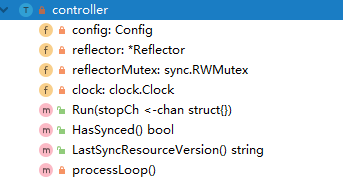
而 controller 则是 SharedInformer 了。
这里的 queue 可以理解为是一个具有 Pop() 功能的 Indexer ;而 Pop() 的功能则是 controller 中的一部分;也就是说 queue 是一个扩展的 Store , Store 是不具备弹出功能的。
type Queue interface { Store // Pop会阻塞等待,直到有内容弹出,删除对应的值并处理计数器 Pop(PopProcessFunc) (interface{}, error) // AddIfNotPresent puts the given accumulator into the Queue (in // association with the accumulator's key) if and only if that key // is not already associated with a non-empty accumulator. AddIfNotPresent(interface{}) error // HasSynced returns true if the first batch of keys have all been // popped. The first batch of keys are those of the first Replace // operation if that happened before any Add, Update, or Delete; // otherwise the first batch is empty. HasSynced() bool Close() // 关闭queue}而弹出的操作是通过 controller 中的 processLoop() 进行的,最终走到Delta FIFO中进行处理。
通过忙等待去读取要弹出的数据,然后在弹出前 通过PopProcessFunc 进行处理
func (c *controller) processLoop() { for { obj, err := c.config.Queue.Pop(PopProcessFunc(c.config.Process)) if err != nil { if err == ErrFIFOClosed { return } if c.config.RetryOnError { // This is the safe way to re-enqueue. c.config.Queue.AddIfNotPresent(obj) } } }}DeltaFIFO.Pop()
func (f *DeltaFIFO) Pop(process PopProcessFunc) (interface{}, error) { f.lock.Lock() defer f.lock.Unlock() for { for len(f.queue) == 0 { // When the queue is empty, invocation of Pop() is blocked until new item is enqueued. // When Close() is called, the f.closed is set and the condition is broadcasted. // Which causes this loop to continue and return from the Pop(). if f.IsClosed() { return nil, ErrFIFOClosed } f.cond.Wait() } id := f.queue[0] f.queue = f.queue[1:] if f.initialPopulationCount > 0 { f.initialPopulationCount-- } item, ok := f.items[id] if !ok { // Item may have been deleted subsequently. continue } delete(f.items, id) err := process(item) // 进行处理 if e, ok := err.(ErrRequeue); ok { f.addIfNotPresent(id, item) // 如果失败,再重新加入到队列中 err = e.Err } // Don't need to copyDeltas here, because we're transferring // ownership to the caller. return item, err }}通过对 Reflector, Store, Queue, ListerWatcher、ProcessFunc, 等的概念,发现由 controller 所包装的起的功能并不能完成通过对API的动作监听,并通过动作来处理本地缓存的一个能力;这个情况下诞生了 informer 严格意义上来讲是 sharedInformer
func newInformer( lw ListerWatcher, objType runtime.Object, resyncPeriod time.Duration, h ResourceEventHandler, clientState Store,) Controller { // This will hold incoming changes. Note how we pass clientState in as a // KeyLister, that way resync operations will result in the correct set // of update/delete deltas. fifo := NewDeltaFIFOWithOptions(DeltaFIFOOptions{ KnownObjects: clientState, EmitDeltaTypeReplaced: true, }) cfg := &Config{ Queue: fifo, ListerWatcher: lw, ObjectType: objType, FullResyncPeriod: resyncPeriod, RetryOnError: false, Process: func(obj interface{}) error { // from oldest to newest for _, d := range obj.(Deltas) { switch d.Type { case Sync, Replaced, Added, Updated: if old, exists, err := clientState.Get(d.Object); err == nil && exists { if err := clientState.Update(d.Object); err != nil { return err } h.OnUpdate(old, d.Object) } else { if err := clientState.Add(d.Object); err != nil { return err } h.OnAdd(d.Object) } case Deleted: if err := clientState.Delete(d.Object); err != nil { return err } h.OnDelete(d.Object) } } return nil }, } return New(cfg)}newInformer是位于 tools/cache/controller.go 下,可以看出,这里面并没有informer的概念,这里通过注释可以看到,newInformer实际上是一个提供了存储和事件通知的informer。他关联的 queue 则是 Delta FIFO,并包含了 ProcessFunc, Store 等 controller的概念。最终对外的方法为 NewInformer()
func NewInformer( lw ListerWatcher, objType runtime.Object, resyncPeriod time.Duration, h ResourceEventHandler,) (Store, Controller) { // This will hold the client state, as we know it. clientState := NewStore(DeletionHandlingMetaNamespaceKeyFunc) return clientState, newInformer(lw, objType, resyncPeriod, h, clientState)}type ResourceEventHandler interface { OnAdd(obj interface{}) OnUpdate(oldObj, newObj interface{}) OnDelete(obj interface{})}可以看到 NewInformer() 就是一个带有 Store功能的controller,通过这些可以假定出,Informer 就是controller ,将queue中相关操作分发给不同事件处理的功能
shareInformer 为客户端提供了与apiserver一致的数据对象本地缓存,并支持多事件处理程序的informer,而 shareIndexInformer 则是对shareInformer 的扩展
type SharedInformer interface { // AddEventHandler adds an event handler to the shared informer using the shared informer's resync // period. Events to a single handler are delivered sequentially, but there is no coordination // between different handlers. AddEventHandler(handler ResourceEventHandler) // AddEventHandlerWithResyncPeriod adds an event handler to the // shared informer with the requested resync period; zero means // this handler does not care about resyncs. The resync operation // consists of delivering to the handler an update notification // for every object in the informer's local cache; it does not add // any interactions with the authoritative storage. Some // informers do no resyncs at all, not even for handlers added // with a non-zero resyncPeriod. For an informer that does // resyncs, and for each handler that requests resyncs, that // informer develops a nominal resync period that is no shorter // than the requested period but may be longer. The actual time // between any two resyncs may be longer than the nominal period // because the implementation takes time to do work and there may // be competing load and scheduling noise. AddEventHandlerWithResyncPeriod(handler ResourceEventHandler, resyncPeriod time.Duration) // GetStore returns the informer's local cache as a Store. GetStore() Store // GetController is deprecated, it does nothing useful GetController() Controller // Run starts and runs the shared informer, returning after it stops. // The informer will be stopped when stopCh is closed. Run(stopCh <-chan struct{}) // HasSynced returns true if the shared informer's store has been // informed by at least one full LIST of the authoritative state // of the informer's object collection. This is unrelated to "resync". HasSynced() bool // LastSyncResourceVersion is the resource version observed when last synced with the underlying // store. The value returned is not synchronized with access to the underlying store and is not // thread-safe. LastSyncResourceVersion() string}SharedIndexInformer 是对SharedInformer的实现,可以从结构中看出,SharedIndexInformer 大致具有如下功能:
Deltal FIFOtype sharedIndexInformer struct { indexer Indexer // 具有索引的本地缓存 controller Controller // controller processor *sharedProcessor // 事件处理函数集合 cacheMutationDetector MutationDetector listerWatcher ListerWatcher objectType runtime.Object resyncCheckPeriod time.Duration defaultEventHandlerResyncPeriod time.Duration clock clock.Clock started, stopped bool startedLock sync.Mutex blockDeltas sync.Mutex}而在 tools/cache/share_informer.go 可以看到 shareIndexInformer 的运行过程
func (s *sharedIndexInformer) Run(stopCh <-chan struct{}) { defer utilruntime.HandleCrash() fifo := NewDeltaFIFOWithOptions(DeltaFIFOOptions{ KnownObjects: s.indexer, EmitDeltaTypeReplaced: true, }) cfg := &Config{ Queue: fifo, ListerWatcher: s.listerWatcher, ObjectType: s.objectType, FullResyncPeriod: s.resyncCheckPeriod, RetryOnError: false, ShouldResync: s.processor.shouldResync, Process: s.HandleDeltas, // process 弹出时操作的流程 } func() { s.startedLock.Lock() defer s.startedLock.Unlock() s.controller = New(cfg) s.controller.(*controller).clock = s.clock s.started = true }() // Separate stop channel because Processor should be stopped strictly after controller processorStopCh := make(chan struct{}) var wg wait.Group defer wg.Wait() // Wait for Processor to stop defer close(processorStopCh) // Tell Processor to stop wg.StartWithChannel(processorStopCh, s.cacheMutationDetector.Run) wg.StartWithChannel(processorStopCh, s.processor.run) // 启动事件处理函数 defer func() { s.startedLock.Lock() defer s.startedLock.Unlock() s.stopped = true // Don't want any new listeners }() s.controller.Run(stopCh) // 启动controller,controller会启动Reflector和fifo的Pop()}而在操作Delta FIFO中可以看到,做具体操作时,会将动作分发至对应的事件处理函数中,这个是informer初始化时对事件操作的函数
func (s *sharedIndexInformer) HandleDeltas(obj interface{}) error { s.blockDeltas.Lock() defer s.blockDeltas.Unlock() for _, d := range obj.(Deltas) { switch d.Type { case Sync, Replaced, Added, Updated: s.cacheMutationDetector.AddObject(d.Object) if old, exists, err := s.indexer.Get(d.Object); err == nil && exists { if err := s.indexer.Update(d.Object); err != nil { return err } isSync := false switch { case d.Type == Sync: isSync = true case d.Type == Replaced: if accessor, err := meta.Accessor(d.Object); err == nil { if oldAccessor, err := meta.Accessor(old); err == nil { isSync = accessor.GetResourceVersion() == oldAccessor.GetResourceVersion() } } } // 事件的分发 s.processor.distribute(updateNotification{oldObj: old, newObj: d.Object}, isSync) } else { if err := s.indexer.Add(d.Object); err != nil { return err } // 事件的分发 s.processor.distribute(addNotification{newObj: d.Object}, false) } case Deleted: if err := s.indexer.Delete(d.Object); err != nil { return err } s.processor.distribute(deleteNotification{oldObj: d.Object}, false) } } return nil}启动informer时也会启动注册进来的事件处理函数;processor 就是这个事件处理函数。
run() 函数会启动两个 listener,j监听事件处理业务函数 listener.run 和 事件的处理
wg.StartWithChannel(processorStopCh, s.processor.run)func (p *sharedProcessor) run(stopCh <-chan struct{}) { func() { p.listenersLock.RLock() defer p.listenersLock.RUnlock() for _, listener := range p.listeners { p.wg.Start(listener.run) p.wg.Start(listener.pop) } p.listenersStarted = true }() <-stopCh p.listenersLock.RLock() defer p.listenersLock.RUnlock() for _, listener := range p.listeners { close(listener.addCh) // Tell .pop() to stop. .pop() will tell .run() to stop } p.wg.Wait() // Wait for all .pop() and .run() to stop}可以看出,就是拿到的事件,根据注册的到informer的事件函数进行处理
func (p *processorListener) run() { stopCh := make(chan struct{}) wait.Until(func() { for next := range p.nextCh { // 消费事件 switch notification := next.(type) { case updateNotification: p.handler.OnUpdate(notification.oldObj, notification.newObj) case addNotification: p.handler.OnAdd(notification.newObj) case deleteNotification: p.handler.OnDelete(notification.oldObj) default: utilruntime.HandleError(fmt.Errorf("unrecognized notification: %T", next)) } } // the only way to get here is if the p.nextCh is empty and closed close(stopCh) }, 1*time.Second, stopCh)}了解了informer如何处理事件,就需要学习下,informer的事件系统设计 prossorListener
当在handleDelta时,会分发具体的事件
// 事件的分发s.processor.distribute(updateNotification{oldObj: old, newObj: d.Object}, isSync)此时,事件泵 Pop() 会根据接收到的事件进行处理
// run() 时会启动一个事件泵p.wg.Start(listener.pop)func (p *processorListener) pop() { defer utilruntime.HandleCrash() defer close(p.nextCh) var nextCh chan<- interface{} var notification interface{} for { select { case nextCh <- notification: // 这里实际上是一个阻塞的等待 // 单向channel 可能不会走到这步骤 var ok bool // deltahandle 中 distribute 会将事件添加到addCh待处理事件中 // 处理完事件会再次拿到一个事件 notification, ok = p.pendingNotifications.ReadOne() if !ok { // Nothing to pop nextCh = nil // Disable this select case } // 处理 分发过来的事件 addCh case notificationToAdd, ok := <-p.addCh: // distribute分发的事件 if !ok { return } // 这里代表第一次,没有任何事件时,或者上面步骤完成读取 if notification == nil { // 就会走这里 notification = notificationToAdd nextCh = p.nextCh } else { // notification否则代表没有处理完,将数据再次添加到待处理中 p.pendingNotifications.WriteOne(notificationToAdd) } } }}该消息事件的流程图为
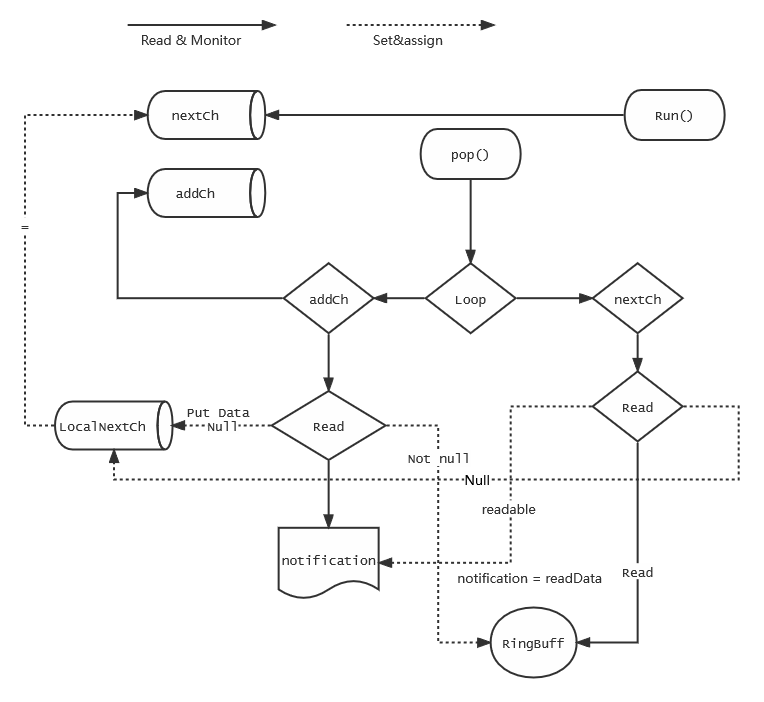
通过一个简单实例来学习client-go中的消息通知机制
package mainimport ( "fmt" "time" "k8s.io/utils/buffer")var nextCh1 = make(chan interface{})var addCh = make(chan interface{})var stopper = make(chan struct{})var notification interface{}var pendding = *buffer.NewRingGrowing(2)func main() { // pop go func() { var nextCh chan<- interface{} var notification interface{} //var n int for { fmt.Println("busy wait") fmt.Println("entry select", notification) select { // 初始时,一个未初始化的channel,nil,形成一个阻塞(单channel下是死锁) case nextCh <- notification: fmt.Println("entry nextCh", notification) var ok bool // 读不到数据代表已处理完,置空锁 notification, ok = pendding.ReadOne() if !ok { fmt.Println("unactive nextch") nextCh = nil } // 事件的分发,监听,初始时也是一个阻塞 case notificationToAdd, ok := <-addCh: fmt.Println(notificationToAdd, notification) if !ok { return } // 线程安全 // 当消息为空时,没有被处理 // 锁为空,就分发数据 if notification == nil { fmt.Println("frist notification nil") notification = notificationToAdd nextCh = nextCh1 // 这步骤等于初始化了局部的nextCh,会触发上面的流程 } else { // 在第三次时,会走到这里,数据进入环 fmt.Println("into ring", notificationToAdd) pendding.WriteOne(notificationToAdd) } } } }() // producer go func() { i := 0 for { i++ if i%5 == 0 { addCh <- fmt.Sprintf("thread 2 inner -- %d", i) time.Sleep(time.Millisecond * 9000) } else { addCh <- fmt.Sprintf("thread 2 outer -- %d", i) time.Sleep(time.Millisecond * 500) } } }() // subsriber go func() { for { for next := range nextCh1 { time.Sleep(time.Millisecond * 300) fmt.Println("consumer", next) } } }() <-stopper}总结,这里的机制类似于线程安全,进入临界区的一些算法,临界区就是 nextCh,notification 就是保证了至少有一个进程可以进入临界区(要么分发事件,要么生产事件);nextCh 和 nextCh1 一个是局部管道一个是全局的,管道未初始化代表了死锁(阻塞);当有消息要处理时,会将局部管道 nextCh 赋值给 全局 nextCh1 此时相当于解除了分发的步骤(对管道赋值,触发分发操作);ringbuffer 实际上是提供了一个对 notification 加锁的操作,在没有处理的消息时,需要保障 notification 为空,同时也关闭了流程 nextCh 的写入。这里主要是考虑对golang中channel的用法