写在前面:
LightGBM 用了很久了,但是一直没有对其进行总结,本文从 LightGBM 的使用、原理及参数调优三个方面进行简要梳理。
使用 LightGBM 官方接口,核心步骤
# 1.定义参数config = json.load(open("configs/lightgbm_config.json", 'r')) # 2. 构造数据index = int(len(features)*0.9)train_fts, train_lbls = features[:index], labels[:index]val_fts, val_lbls = features[index:], labels[index:]train_data = lgb.Dataset(train_fts, label=train_lbls)val_data = lgb.Dataset(val_fts, label=val_lbls)# 3. trainbst = lgb.train(params=config, train_set=train_data, valid_sets=[val_data])# 4. predictlgb.predict(val_data)# lightgbm_config.json{ "objective":"binary", "task":"train", "boosting":"gbdt", "num_iterations":500, "learning_rate":0.1, "max_depth":-1, "num_leaves":64, "tree_learner":"serial", "num_threads":0, "device_type":"cpu", "seed":0, "min_data_in_leaf":100, "min_sum_hessian_in_leaf":0.001, "bagging_fraction":0.9, "bagging_freq":1, "bagging_seed":0, "feature_fraction":0.9, "feature_fraction_bynode":0.9, "feature_fraction_seed":0, "early_stopping_rounds":10, "first_metric_only":true, "max_delta_step":0, "lambda_l1":0, "lambda_l2":1, "verbosity":2, "is_unbalance":true, "sigmoid":1, "boost_from_average":true, "metric":[ "binary_logloss", "auc", "binary_error" ]}import lightgbm as lgb# 1. config"""objective parameter: ‘regression’ for LGBMRegressor ‘binary’ or ‘multiclass’ for LGBMClassifier ‘lambdarank’ for LGBMRanker."""lgb_clf = lgb.LGBMModel( objective = 'binary', metric = 'binary_logloss,auc', learning_rate = 0.1, bagging_fraction = 0.8, feature_fraction = 0.9, bagging_freq = 5, n_estimators = 300, max_depth = 4, is_unbalance = True )# 2. fit# 3. predict在处理大规模数据时,数据无法一次性载入内存,使用增量训练。
主要通过两个参数实现:
详细方法见 增量学习/训练
在LightGBM,Xgboost一直是kaggle的屠榜神器之一,但是,一切都在进步~
贪心算法生成树,时间复杂度\(O(ndKlogn)\),\(d\) 个特征,每个特征排序需要\(O(nlogn)\),树深度为\(K\)
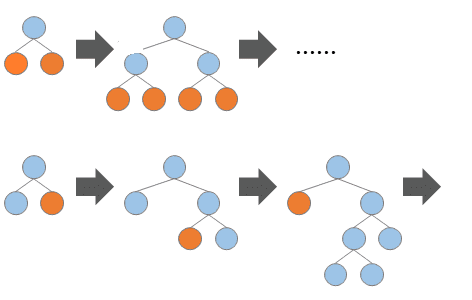
Level-wise 生长,并行计算每一层的分裂节点
内存优化:
时间优化:
Leaf-wise(按叶子生长)生长策略
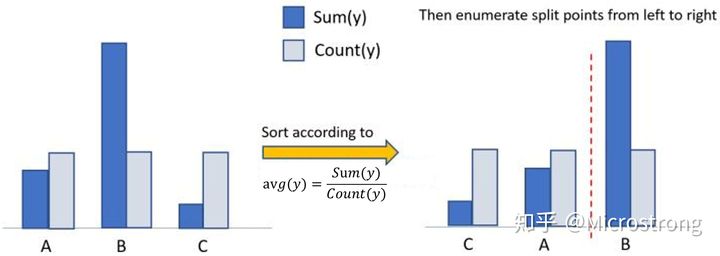
xgboost使用one-hot编码,LightGBM 采用了 Many vs Many 的切分方式,实现过程如下【7】:
将类别的取值当做bin,有多少个取值就是多少个bin(去除样本极少的bin)
统计该特征中的各取值上的样本数,按照从样本数从大到小排序,去除样本占比小于1%的类别值
对于剩余的特征值(可以理解为一个特征值对应一个桶),统计各个特征值对应的样本的一阶梯度之和,二阶梯度之和,根据正则化系数,算得各个桶的统计量: 一阶梯度之和 / (二阶梯度之和 + 正则化系数);
根据该统计量对各个桶进行从大到小排序;在排序好的桶上,进行最佳切点查找
is_unbalance=True,表示 正样本的权重/负样本的权重 等于负样本的样本数/正样本的样本数scale_pos_weight,代表的是正类的权重,可以设置为 number of negative samples / number of positive samplesclass weightboosting / boost / boosting_type
用于指定弱学习器的类型,默认值为 ‘gbdt’,表示使用基于树的模型进行计算。还可以选择为 ‘gblinear’ 表示使用线性模型作为弱学习器。
‘gbdt’,使用梯度提升树‘rf’,使用随机森林‘dart’,不太了解,官方解释为 Dropouts meet Multiple Additive Regression Trees‘goss’,使用单边梯度抽样算法,速度很快,但是可能欠拟合。objective / application
“regression”,使用L2正则项的回归模型(默认值)。“regression_l1”,使用L1正则项的回归模型。“mape”,平均绝对百分比误差。“binary”,二分类。“multiclass”,多分类。num_class
多分类问题的类别个数增量训练
keep_training_booster=True # 增量训练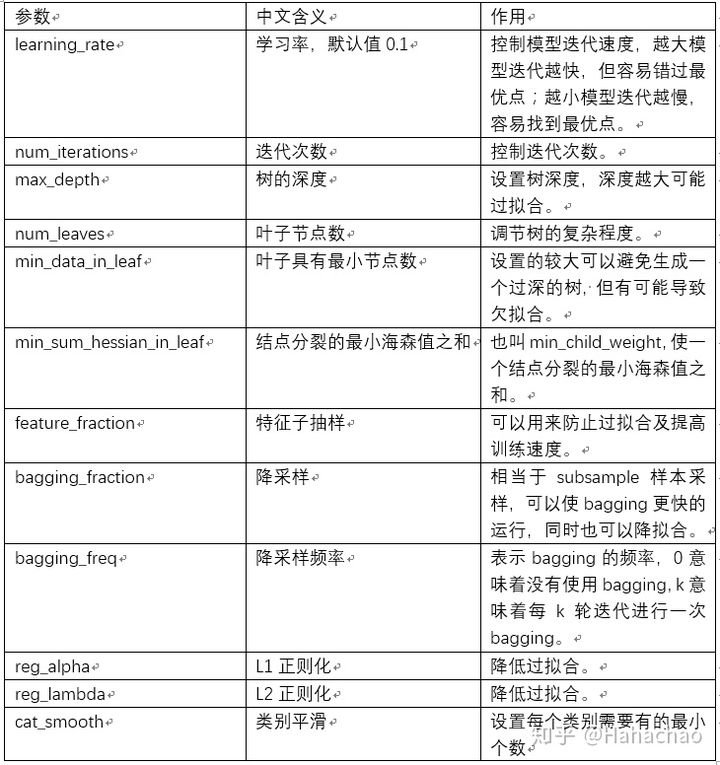
调优思路与方向
2^(max_depth)L1 和 L2 正则化,对应XGBoost 的 reg_lambda 和 reg_alphaLGBM就会提示warning,无法找到可以分裂的了,说明数据质量已经达到了极限了。参数含义和 XGBoost 的 gamma 是一样。比较保守的搜索范围是 (0, 20),它可以用作大型参数网格中的额外正则化使用Optuna,定义优化目标函数:
import optuna # pip install optunafrom sklearn.metrics import log_lossfrom sklearn.model_selection import StratifiedKFoldfrom optuna.integration import LightGBMPruningCallbackdef objective(trial, X, y): param_grid = { "n_estimators": trial.suggest_categorical("n_estimators", [10000]), "learning_rate": trial.suggest_float("learning_rate", 0.01, 0.3), "num_leaves": trial.suggest_int("num_leaves", 20, 3000, step=20), "max_depth": trial.suggest_int("max_depth", 3, 12), "min_data_in_leaf": trial.suggest_int("min_data_in_leaf", 200, 10000, step=100), "max_bin": trial.suggest_int("max_bin", 200, 300), "lambda_l1": trial.suggest_int("lambda_l1", 0, 100, step=5), "lambda_l2": trial.suggest_int("lambda_l2", 0, 100, step=5), "min_gain_to_split": trial.suggest_float("min_gain_to_split", 0, 15), "bagging_fraction": trial.suggest_float( "bagging_fraction", 0.2, 0.95, step=0.1 ), "bagging_freq": trial.suggest_categorical("bagging_freq", [1]), "feature_fraction": trial.suggest_float( "feature_fraction", 0.2, 0.95, step=0.1 ), } cv = StratifiedKFold(n_splits=5, shuffle=True, random_state=1121218) cv_scores = np.empty(5) for idx, (train_idx, test_idx) in enumerate(cv.split(X, y)): X_train, X_test = X.iloc[train_idx], X.iloc[test_idx] y_train, y_test = y[train_idx], y[test_idx] model = lgbm.LGBMClassifier(objective="binary", **param_grid) model.fit( X_train, y_train, eval_set=[(X_test, y_test)], eval_metric="binary_logloss", early_stopping_rounds=100, callbacks=[ LightGBMPruningCallback(trial, "binary_logloss") ], ) preds = model.predict_proba(X_test) preds = model.predict_proba(X_test) # 优化指标logloss最小 cv_scores[idx] = log_loss(y_test, preds) return np.mean(cv_scores)调优
study = optuna.create_study(direction="minimize", study_name="LGBM Classifier")func = lambda trial: objective(trial, X, y)study.optimize(func, n_trials=20)搜索完成后,调用best_value和bast_params属性,调参就出来了。
print(f"\tBest value (rmse): {study.best_value:.5f}")print(f"\tBest params:")for key, value in study.best_params.items(): print(f"\t\t{key}: {value}")-----------------------------------------------------Best value (binary_logloss): 0.35738 Best params: device: gpu lambda_l1: 7.71800699380605e-05 lambda_l2: 4.17890272377219e-06 bagging_fraction: 0.7000000000000001 feature_fraction: 0.4 bagging_freq: 5 max_depth: 5 num_leaves: 1007 min_data_in_leaf: 45 min_split_gain: 15.703519227860273 learning_rate: 0.010784015325759629 n_estimators: 10000得到这个参数组合后,我们就可以拿去跑模型了,看结果再手动微调,这样就可以省很多时间了。
lgb_clf.feature_importances_【1】详解LightGBM两大利器:基于梯度的单边采样(GOSS)和互斥特征捆绑(EFB)https://zhuanlan.zhihu.com/p/366234433
【2】LightGBM的参数详解以及如何调优. https://cloud.tencent.com/developer/article/1696852
【3】LightGBM 中文文档. https://lightgbm.cn/
【4】决策树(下)——XGBoost、LightGBM(非常详细)https://zhuanlan.zhihu.com/p/87885678
【5】http://www.showmeai.tech/article-detail/195
【6】https://zhuanlan.zhihu.com/p/99069186
【7】lightgbm离散类别型特征为什么按照每一个类别里对应样本的一阶梯度求和/二阶梯度求和排序? - 一直学习一直爽的回答 - 知乎 https://www.zhihu.com/question/386888889/answer/1195897410
【8】LightGBM+OPTUNA超参数自动调优教程
【9】LightGBM with the Focal Loss for imbalanced datasets