试想一下我们一般怎么统一处理异常呢,答:切面。但抛开切面不讲,如果对每一个controller方法抛出的异常做专门处理,那么着实太费劲了,有没有更好的方法呢?当然有,就是本篇文章接下来要介绍的springmvc的异常处理机制,用到了ControllerAdvice和ExceptionHandler注解,有点切面的感觉哈哈。
首先从springmvc的异常处理解析器开始讲,当执行完controller方法后,不管有没有异常产生都会调用DispatcherServlet#doDispatch()方法中的processDispatchResult(processedRequest, response, mappedHandler, mv, dispatchException); 方法,接着会判断是否有异常,若无异常则走正常流程,若有异常则需要进行处理 mv = processHandlerException(request, response, handler, exception); 再接着就是遍历spring已经注册的异常处理解析器直到有处理器返回mav
private void processDispatchResult(HttpServletRequest request, HttpServletResponse response, @Nullable HandlerExecutionChain mappedHandler, @Nullable ModelAndView mv, @Nullable Exception exception) throws Exception { if (exception != null) { if (exception instanceof ModelAndViewDefiningException) { logger.debug("ModelAndViewDefiningException encountered", exception); mv = ((ModelAndViewDefiningException) exception).getModelAndView(); } else { Object handler = (mappedHandler != null ? mappedHandler.getHandler() : null); // 执行处理器产生的异常处理 mv = processHandlerException(request, response, handler, exception); // 是否有异常视图返回 errorView = (mv != null); } } // Did the handler return a view to render? 处理程序是否返回要渲染的视图 if (mv != null && !mv.wasCleared()) { // 渲染视图 render(mv, request, response); if (errorView) { WebUtils.clearErrorRequestAttributes(request); } } else { if (logger.isDebugEnabled()) { logger.debug("Null ModelAndView returned to DispatcherServlet with name '" + getServletName() + "': assuming HandlerAdapter completed request handling"); } } } @Nullable protected ModelAndView processHandlerException(HttpServletRequest request, HttpServletResponse response, @Nullable Object handler, Exception ex) throws Exception { // Check registered HandlerExceptionResolvers... ModelAndView exMv = null; if (this.handlerExceptionResolvers != null) { for (HandlerExceptionResolver handlerExceptionResolver : this.handlerExceptionResolvers) { exMv = handlerExceptionResolver.resolveException(request, response, handler, ex); if (exMv != null) { break; } } } if (exMv != null) { // 无视图view if (exMv.isEmpty()) { request.setAttribute(EXCEPTION_ATTRIBUTE, ex); return null; } // We might still need view name translation for a plain error model... if (!exMv.hasView()) { String defaultViewName = getDefaultViewName(request); if (defaultViewName != null) { exMv.setViewName(defaultViewName); } } WebUtils.exposeErrorRequestAttributes(request, ex, getServletName()); return exMv; } throw ex; }
其中最重要也是最常使用的一个处理器就是ExceptionHandlerExceptionResolver,下面将着重介绍它,先来看看这个类的继承结构图,实现了InitializingBean接口,在这个bean创建完成之前会调用生命周期初始化方法afterPropertiesSet(),这里面包含了对@ControllerAdvice注解的解析,初始化完后的信息供后续解析异常使用。
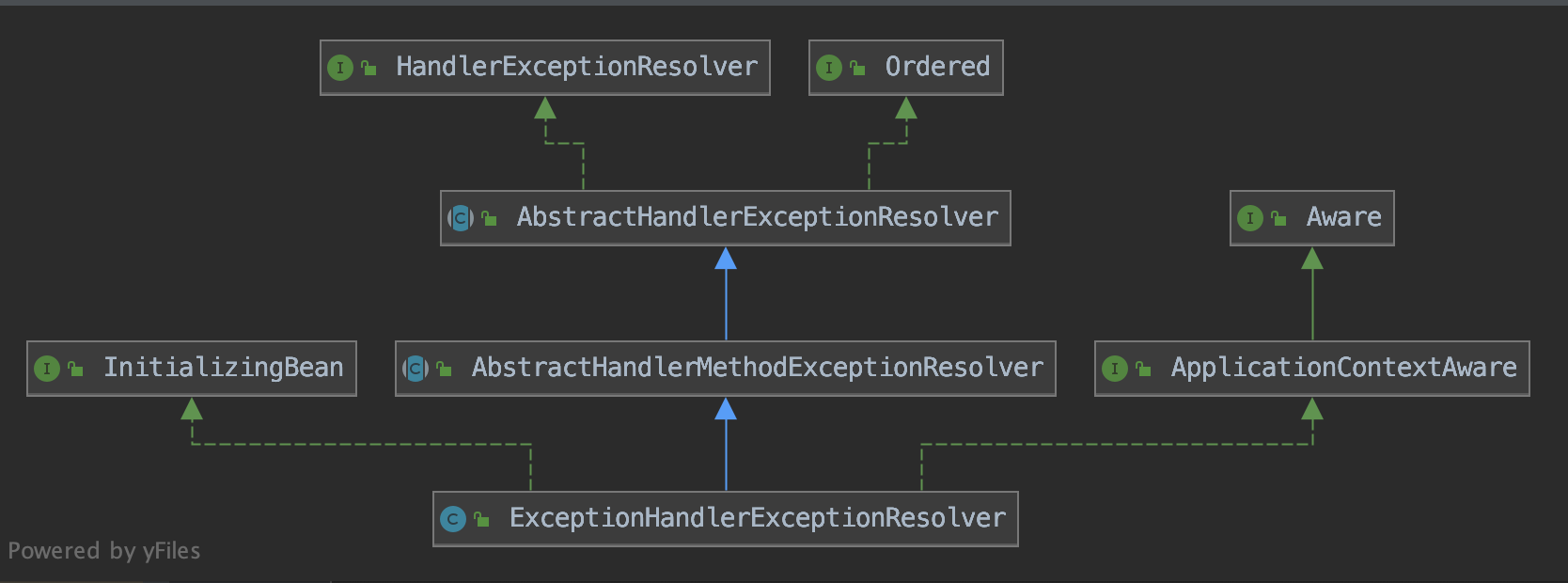
实现HandlerExceptionResolver接口,实现解析方法resolveException()
public interface HandlerExceptionResolver { /** * Try to resolve the given exception that got thrown during handler execution, * returning a {@link ModelAndView} that represents a specific error page if appropriate. * <p>The returned {@code ModelAndView} may be {@linkplain ModelAndView#isEmpty() empty} * to indicate that the exception has been resolved successfully but that no view * should be rendered, for instance by setting a status code. * @param request current HTTP request * @param response current HTTP response * @param handler the executed handler, or {@code null} if none chosen at the * time of the exception (for example, if multipart resolution failed) * @param ex the exception that got thrown during handler execution * @return a corresponding {@code ModelAndView} to forward to, * or {@code null} for default processing in the resolution chain */ @Nullable ModelAndView resolveException( HttpServletRequest request, HttpServletResponse response, @Nullable Object handler, Exception ex);}@Overridepublic void afterPropertiesSet() { // Do this first, it may add ResponseBodyAdvice beans // 初始化异常注解 @ControllerAdvice initExceptionHandlerAdviceCache();}private void initExceptionHandlerAdviceCache() { if (getApplicationContext() == null) { return; } if (logger.isDebugEnabled()) { logger.debug("Looking for exception mappings: " + getApplicationContext()); } // 解析有@ControllerAdvice注解的bean,并将这个bean构建成ControllerAdviceBean对象 List<ControllerAdviceBean> adviceBeans = ControllerAdviceBean.findAnnotatedBeans(getApplicationContext()); // 将ControllerAdviceBean根据order排序 AnnotationAwareOrderComparator.sort(adviceBeans); for (ControllerAdviceBean adviceBean : adviceBeans) { Class<?> beanType = adviceBean.getBeanType(); if (beanType == null) { throw new IllegalStateException("Unresolvable type for ControllerAdviceBean: " + adviceBean); } ExceptionHandlerMethodResolver resolver = new ExceptionHandlerMethodResolver(beanType); // mappedMethods 映射不为空 if (resolver.hasExceptionMappings()) { // 添加到缓存中 this.exceptionHandlerAdviceCache.put(adviceBean, resolver); if (logger.isInfoEnabled()) { logger.info("Detected @ExceptionHandler methods in " + adviceBean); } } // 若实现了ResponseBodyAdvice接口(暂不介绍) if (ResponseBodyAdvice.class.isAssignableFrom(beanType)) { this.responseBodyAdvice.add(adviceBean); if (logger.isInfoEnabled()) { logger.info("Detected ResponseBodyAdvice implementation in " + adviceBean); } } }} ExceptionHandlerMethodResolver resolver = new ExceptionHandlerMethodResolver(beanType); 这行代码会解析拥有@ControllerAdvice 注解的class,并且会遍历class中带有 @ExceptionHandler 注解的方法,获取方法注解带有的异常类型,将异常类型和方法放入到mappedMethods中供后面获取,获取的时候若对应处理此异常类型的method有多个,则需要进行排序,选取一个异常类型与method ExceptionHandler注解异常类型最近的一个(深度最小的那个也即是继承关系最少的那个)具体代码如下:
public class ExceptionHandlerMethodResolver { /** * A filter for selecting {@code @ExceptionHandler} methods. */ public static final MethodFilter EXCEPTION_HANDLER_METHODS = method -> (AnnotationUtils.findAnnotation(method, ExceptionHandler.class) != null); /** * 异常类型与方法的映射map */ private final Map<Class<? extends Throwable>, Method> mappedMethods = new HashMap<>(16); /** * 缓存,用来存储先前碰到过的异常类型与处理方法的映射 */ private final Map<Class<? extends Throwable>, Method> exceptionLookupCache = new ConcurrentReferenceHashMap<>(16); /** * A constructor that finds {@link ExceptionHandler} methods in the given type. * @param handlerType the type to introspect */ public ExceptionHandlerMethodResolver(Class<?> handlerType) { // 获取并遍历@ExceptionHandler注解的方法 for (Method method : MethodIntrospector.selectMethods(handlerType, EXCEPTION_HANDLER_METHODS)) { for (Class<? extends Throwable> exceptionType : detectExceptionMappings(method)) { addExceptionMapping(exceptionType, method); } } } /** * Extract exception mappings from the {@code @ExceptionHandler} annotation first, * and then as a fallback from the method signature itself. */ @SuppressWarnings("unchecked") private List<Class<? extends Throwable>> detectExceptionMappings(Method method) { List<Class<? extends Throwable>> result = new ArrayList<>(); // 将注解ExceptionHandler value值异常添加到result中 detectAnnotationExceptionMappings(method, result); // 注解值为空的话再去获取参数的异常类型 if (result.isEmpty()) { for (Class<?> paramType : method.getParameterTypes()) { if (Throwable.class.isAssignableFrom(paramType)) { result.add((Class<? extends Throwable>) paramType); } } } if (result.isEmpty()) { throw new IllegalStateException("No exception types mapped to " + method); } return result; } protected void detectAnnotationExceptionMappings(Method method, List<Class<? extends Throwable>> result) { ExceptionHandler ann = AnnotationUtils.findAnnotation(method, ExceptionHandler.class); Assert.state(ann != null, "No ExceptionHandler annotation"); result.addAll(Arrays.asList(ann.value())); } private void addExceptionMapping(Class<? extends Throwable> exceptionType, Method method) { // 将异常类型以及对应的method添加到map中,且异常类型不能有重复否则会报错 Method oldMethod = this.mappedMethods.put(exceptionType, method); if (oldMethod != null && !oldMethod.equals(method)) { throw new IllegalStateException("Ambiguous @ExceptionHandler method mapped for [" + exceptionType + "]: {" + oldMethod + ", " + method + "}"); } } /** * Whether the contained type has any exception mappings. */ public boolean hasExceptionMappings() { return !this.mappedMethods.isEmpty(); } /** * Find a {@link Method} to handle the given exception. * Use {@link ExceptionDepthComparator} if more than one match is found. * @param exception the exception * @return a Method to handle the exception, or {@code null} if none found */ @Nullable public Method resolveMethod(Exception exception) { return resolveMethodByThrowable(exception); } /** * Find a {@link Method} to handle the given Throwable. * Use {@link ExceptionDepthComparator} if more than one match is found. * @param exception the exception * @return a Method to handle the exception, or {@code null} if none found * @since 5.0 */ @Nullable public Method resolveMethodByThrowable(Throwable exception) { Method method = resolveMethodByExceptionType(exception.getClass()); if (method == null) { Throwable cause = exception.getCause(); if (cause != null) { method = resolveMethodByExceptionType(cause.getClass()); } } return method; } /** * Find a {@link Method} to handle the given exception type. This can be * useful if an {@link Exception} instance is not available (e.g. for tools). * @param exceptionType the exception type * @return a Method to handle the exception, or {@code null} if none found */ @Nullable public Method resolveMethodByExceptionType(Class<? extends Throwable> exceptionType) { Method method = this.exceptionLookupCache.get(exceptionType); if (method == null) { method = getMappedMethod(exceptionType); this.exceptionLookupCache.put(exceptionType, method); } return method; } /** * Return the {@link Method} mapped to the given exception type, or {@code null} if none. */ @Nullable private Method getMappedMethod(Class<? extends Throwable> exceptionType) { List<Class<? extends Throwable>> matches = new ArrayList<>(); for (Class<? extends Throwable> mappedException : this.mappedMethods.keySet()) { if (mappedException.isAssignableFrom(exceptionType)) { matches.add(mappedException); } } if (!matches.isEmpty()) { // exceptionType 到matchs父类异常类型的深度 matches.sort(new ExceptionDepthComparator(exceptionType)); return this.mappedMethods.get(matches.get(0)); } else { return null; } }}@Override@Nullableprotected ModelAndView doResolveHandlerMethodException(HttpServletRequest request, HttpServletResponse response, @Nullable HandlerMethod handlerMethod, Exception exception) { // exception为controller方法抛出的异常 // 根据异常及其类型从上述的mappedMethods中获取对应的方法,再获取方法所在的对象 封装成ServletInvocableHandlerMethod ServletInvocableHandlerMethod exceptionHandlerMethod = getExceptionHandlerMethod(handlerMethod, exception); if (exceptionHandlerMethod == null) { return null; } // 设置参数解析器,主要用来获取方法的参数值的,供后续反射调用方法 if (this.argumentResolvers != null) { exceptionHandlerMethod.setHandlerMethodArgumentResolvers(this.argumentResolvers); } // 设置返回值解析器,当执行完方法后获取返回值,对返回值进行处理 或返回视图或将结果写入到response if (this.returnValueHandlers != null) { exceptionHandlerMethod.setHandlerMethodReturnValueHandlers(this.returnValueHandlers); } ServletWebRequest webRequest = new ServletWebRequest(request, response); ModelAndViewContainer mavContainer = new ModelAndViewContainer(); try { if (logger.isDebugEnabled()) { logger.debug("Invoking @ExceptionHandler method: " + exceptionHandlerMethod); } Throwable cause = exception.getCause(); if (cause != null) { // Expose cause as provided argument as well // 执行异常处理方法,也就是我们的自定义的异常处理方法 exceptionHandlerMethod.invokeAndHandle(webRequest, mavContainer, exception, cause, handlerMethod); } else { // Otherwise, just the given exception as-is exceptionHandlerMethod.invokeAndHandle(webRequest, mavContainer, exception, handlerMethod); } } catch (Throwable invocationEx) { // Any other than the original exception is unintended here, // probably an accident (e.g. failed assertion or the like). if (invocationEx != exception && logger.isWarnEnabled()) { logger.warn("Failed to invoke @ExceptionHandler method: " + exceptionHandlerMethod, invocationEx); } // Continue with default processing of the original exception... return null; } // 根据后续的返回值解析器设置的,将返回值写入到response中了直接返回空的mav if (mavContainer.isRequestHandled()) { return new ModelAndView(); } else { ModelMap model = mavContainer.getModel(); HttpStatus status = mavContainer.getStatus(); ModelAndView mav = new ModelAndView(mavContainer.getViewName(), model, status); mav.setViewName(mavContainer.getViewName()); // (this.view instanceof String) if (!mavContainer.isViewReference()) { mav.setView((View) mavContainer.getView()); } if (model instanceof RedirectAttributes) { Map<String, ?> flashAttributes = ((RedirectAttributes) model).getFlashAttributes(); RequestContextUtils.getOutputFlashMap(request).putAll(flashAttributes); } return mav; }}exceptionHandlerMethod.invokeAndHandle(webRequest, mavContainer, exception, cause, handlerMethod); 此方法执行完成后已经完成了异常处理方法的调用,若方法返回值为视图ModelAndView或其他视图类型,则还需要借助视图解析器如InternalResourceViewResolver对视图进行解析渲染,若为其他类型的值则将值写入到response响应中。
Controller类方法:
@Controller@RequestMapping(value = "test")public class HelloWorldController{ @Data public static class User { private String username; private Integer age; private String address; } @RequestMapping(value = "user/get", method = RequestMethod.POST) @ResponseBody public Object testObject(@RequestBody @Valid User user, @RequestParam String address) { user.setAddress(address); // 这里特意抛出RuntimeException异常 throw new RuntimeException("this is a exception"); }}ExceptionHandlerController异常处理类
@ControllerAdvice@ResponseBodypublic class ExceptionHandlerController { @ExceptionHandler(value = Exception.class) public Object handleException(Exception e) { return CommonResult.fail("Exception:" + e.getMessage()); } @ExceptionHandler(value = RuntimeException.class) public Object handlerRuntimeException(Exception e) { return CommonResult.fail("handlerRuntimeException:" + e.getMessage()); }}ExceptionHandlerController类中定义了两个异常处理方法,一个处理Exception异常,一个处理RuntimeException异常,那个根据controller方法抛出的异常RuntimeException再结合上面的分析(RuntimeException到RuntimeException深度为0,RuntimeException到Exception中间继承了一次深度为1)可以得出抛出异常类型的处理方法为handlerRuntimeException 方法。 运行程序结果如下:
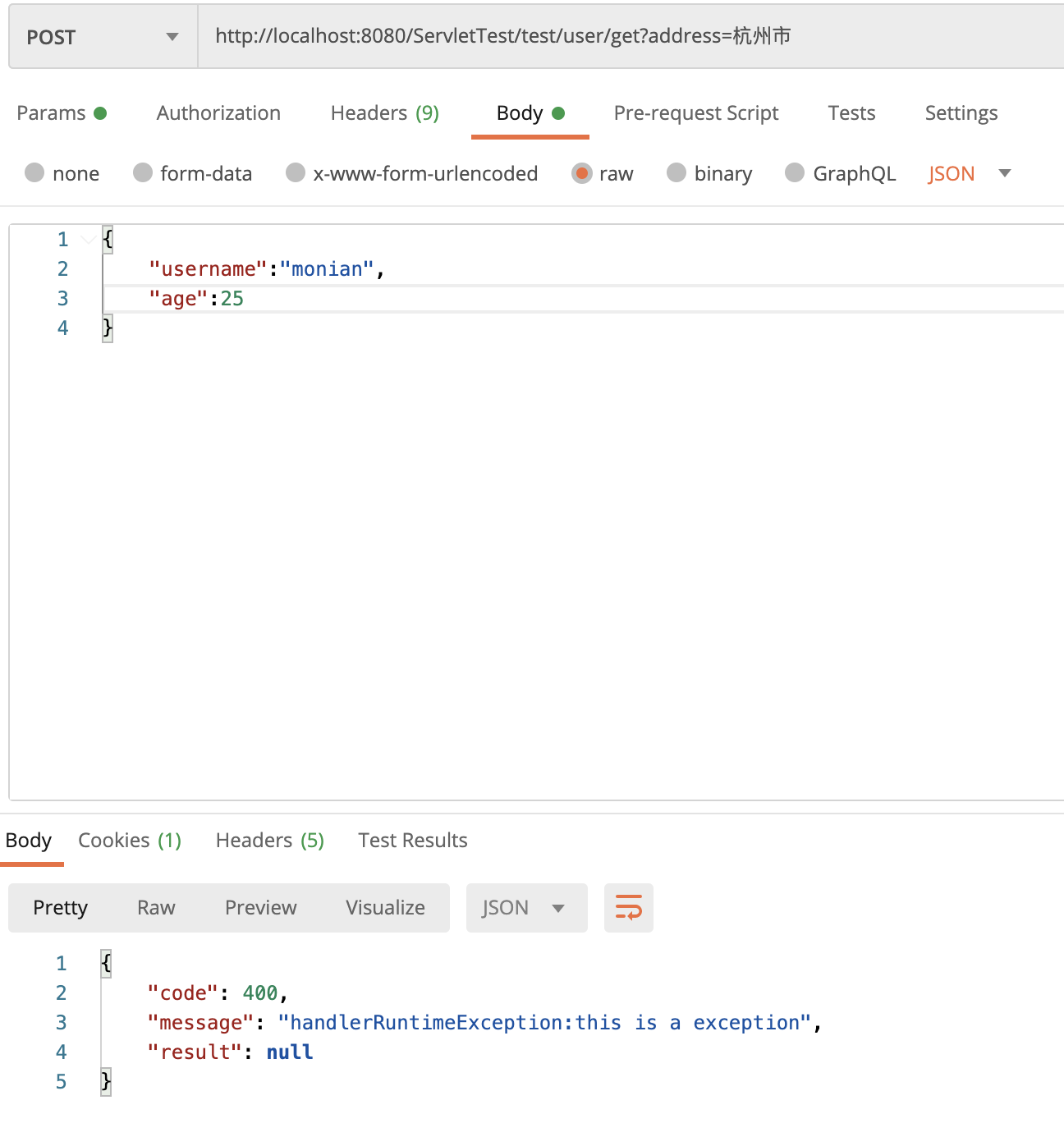
初步解析ExceptionHandlerExceptionResolver源码,若写的有误或者有不理解的地方,欢迎指出讨论~